2008: Why Someone Built Bitcoin
A headline hidden in block 0

On 3 January 2009, the first Bitcoin block was created: the genesis block, or block 0. Hidden in its data is a line from that day’s front page of The Times: “Chancellor on brink of second bailout for banks”. It works like a date stamp, and many read it as a comment on banks being rescued with public money.
By the end of this chapter you can explain what problem Bitcoin was built to solve, and tell a fact about its design from a claim about its price. New to Bitcoin? Start with the five-minute lesson What is Bitcoin?
2008: a crisis of trust
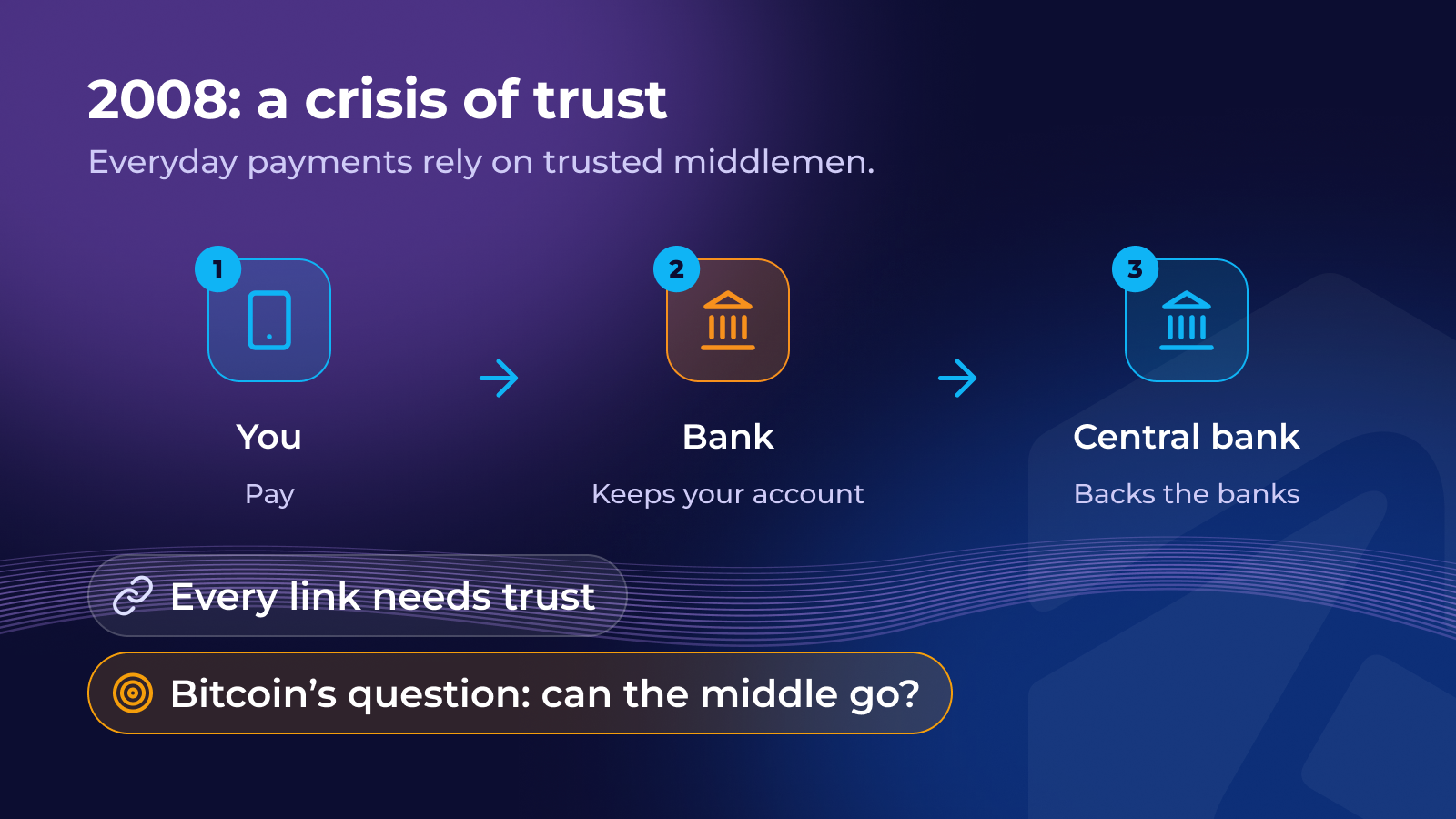
On 15 September 2008, the US bank Lehman Brothers went bankrupt, and governments in the US, the UK and across Europe spent huge sums rescuing banks. The crisis showed how much everyday money depends on trusting the institutions in the middle. In February 2009, Bitcoin’s creator wrote: “The root problem with conventional currency is all the trust that’s required to make it work.”
Earlier digital cash hadn’t removed that middle. DigiCash (1989–1998) needed a company and partner banks, and other designs never launched; Before Bitcoin: The Search for Digital Cash tells that story. The unsolved part: how strangers can agree on who owns what without trusting each other.
Quick check
Early digital cash: what kept systems like DigiCash from working without a company in the middle?
Nine pages, four ideas
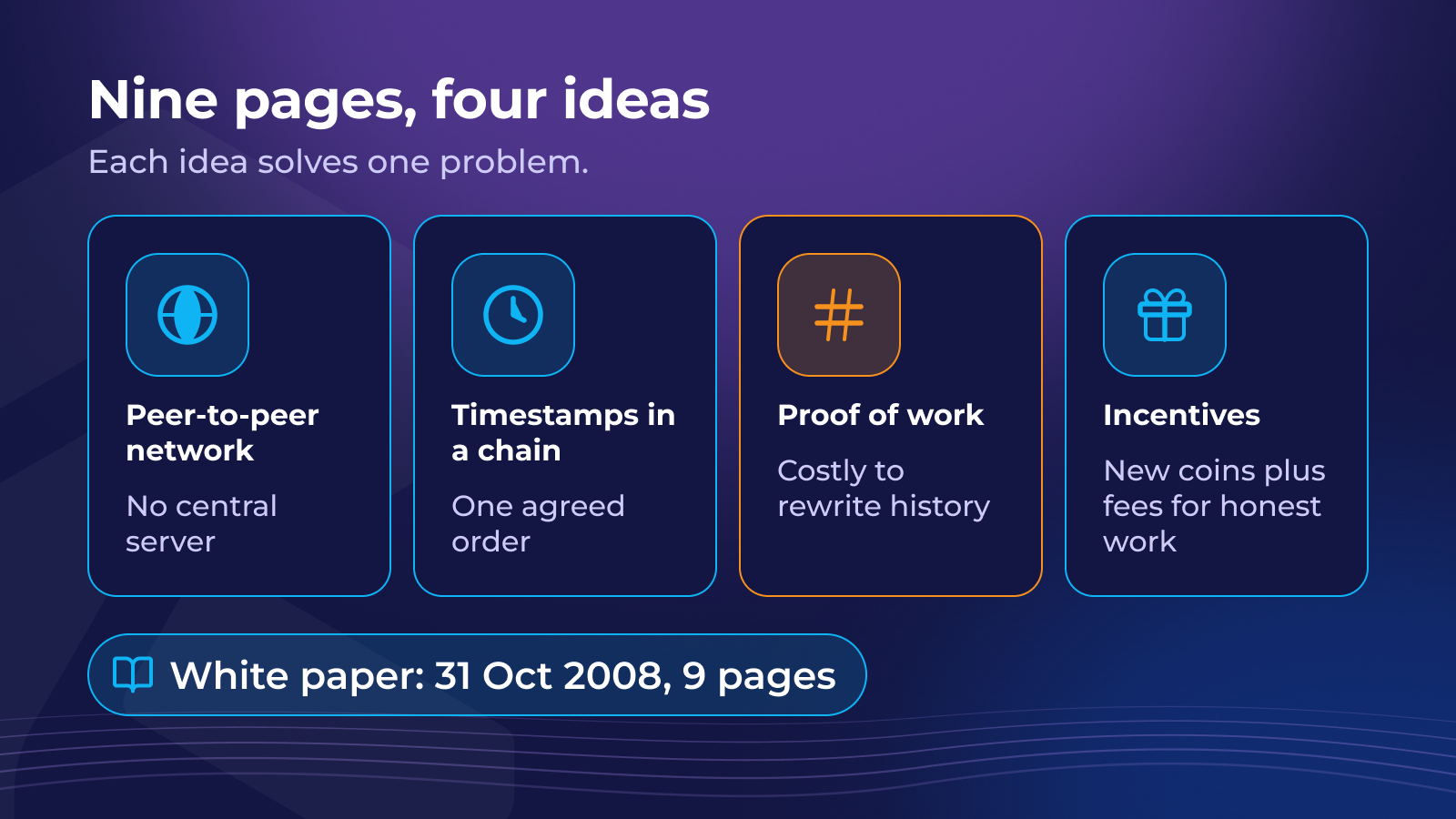
On 31 October 2008, someone using the name Satoshi Nakamoto posted a nine-page paper: “Bitcoin: A Peer-to-Peer Electronic Cash System” (bitcoin.org/bitcoin.pdf). It combines four ideas: a peer-to-peer network with no central server, timestamps in a chain of blocks, proof of work that makes rewriting history expensive, and incentives: new coins plus fees for whoever adds a block.
The paper has no prices or investment promises, and the 21 million limit isn’t in it; that was set in the software. A habit for this whole course:
- Facts about the design: what the software does. You can check these.
- Claims about value (“digital gold”, “it can only go up”): opinions or predictions. Nobody can check these in advance.
Quick check
Bitcoin facts vs claims: which statement is a fact about Bitcoin’s design that you can check?
Who is Satoshi Nakamoto?
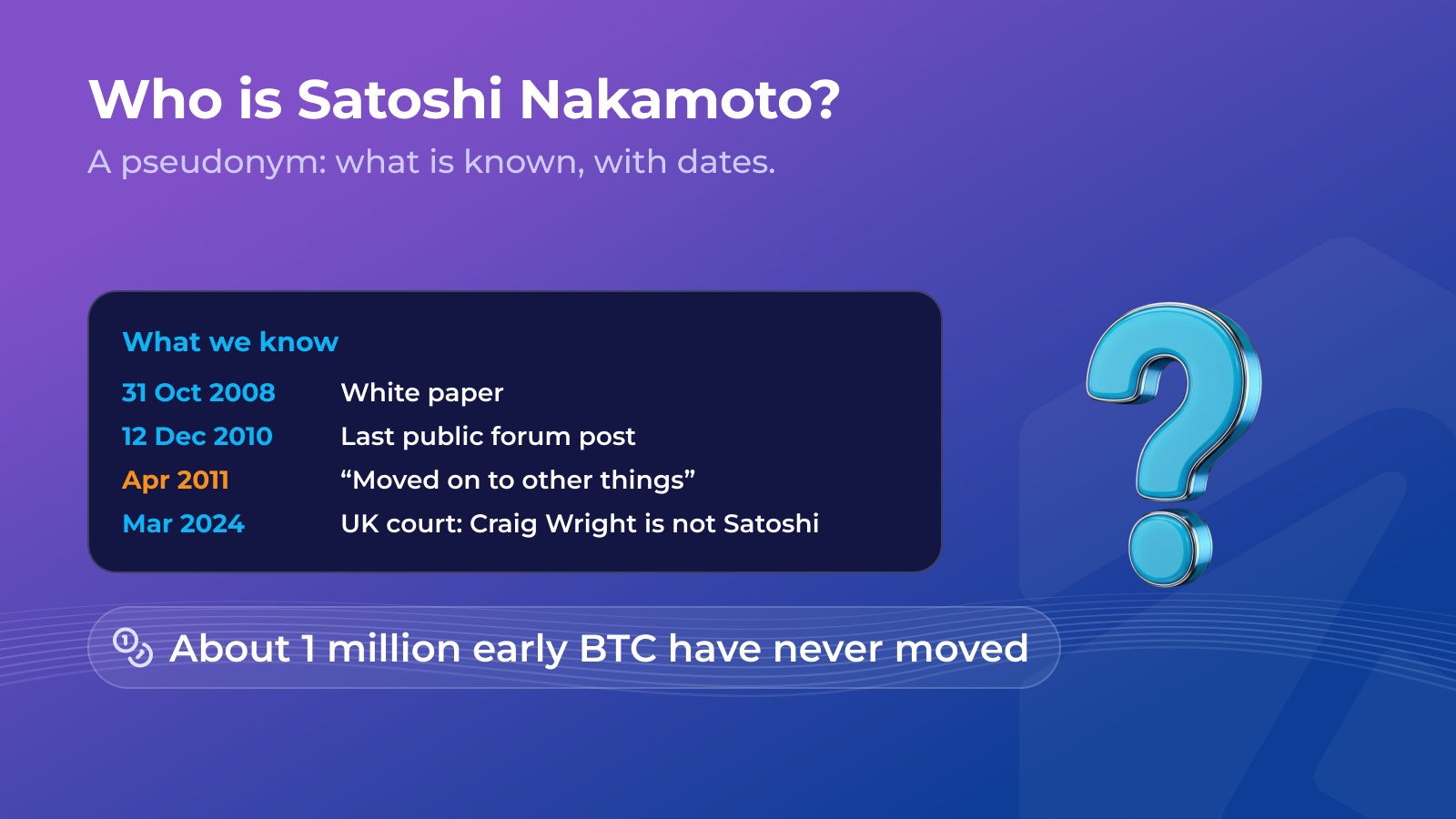
Nobody knows for sure. “Satoshi Nakamoto” is a pseudonym, used by a person or a group. The last public forum post is dated 12 December 2010; in April 2011 Satoshi wrote of having “moved on to other things”. Early coins probably mined by Satoshi, an estimated 1 million BTC, have never moved.
In March 2024 the High Court in London ruled that Craig Wright, who claimed to be Satoshi, is not; its written judgment in May 2024 found that he had relied on forged documents.
No founder cuts both ways: nobody can change the rules alone, and there’s nobody to complain to. The lesson Satoshi Nakamoto: What We Know and What We Don’t goes deeper.
Quick check
Bitcoin rules: a video says “Satoshi could raise Bitcoin’s 21 million limit tomorrow.” Is that right?
Recap: why Bitcoin exists

Remember:
- Bitcoin began after the 2008 crisis of trust: the white paper on 31 October 2008, block 0 on 3 January 2009.
- Its new idea: strangers agreeing on one record, with no company in the middle and no founder in charge.
- Design facts can be checked; price claims are opinions.
Crypto prices can rise and fall sharply, and you could lose some or all of the money you put in. Crypto is not covered by deposit protection. This lesson is education, not financial advice.
Next: why can’t digital money simply be copied? The Double-Spend Problem
Lesson complete!
0 / 3
That's the first chapter. Continue this course — and unlock the rest — in the Rumos app.