What Money Does
Three jobs, one tool
By the end you can name the three jobs of money and say how well cash, bank money and crypto do each.
Imagine you cut hair and want eggs. Without money, you'd need a farmer who wants a haircut today. That is barter, and it is slow.
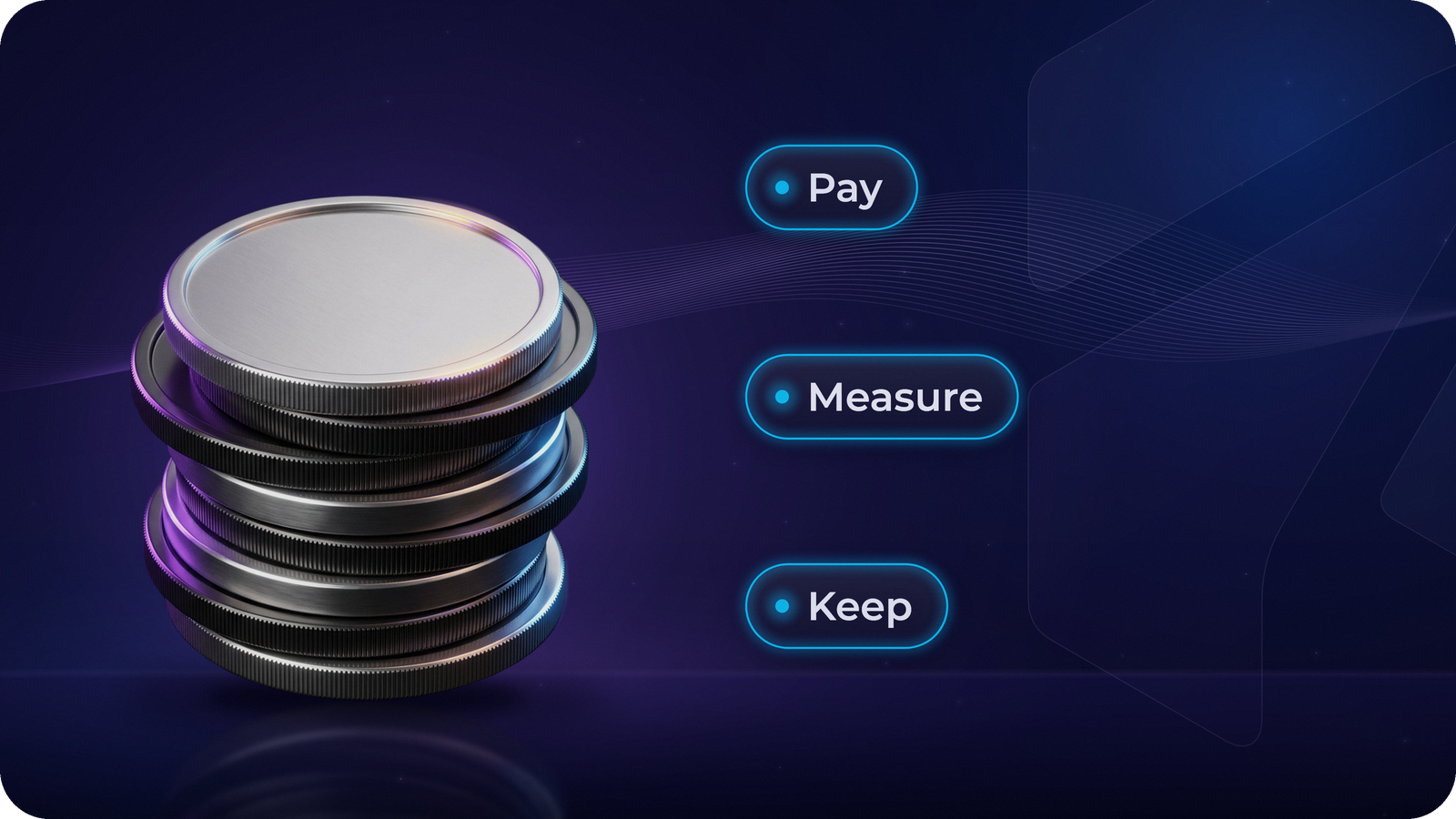
Money fixes this. It does three jobs at once:
- Pay: almost everyone accepts it, so you can swap work for things.
- Measure: prices are written in it, so you can compare a haircut with a dozen eggs.
- Keep: you can hold it today and spend it next month.
Economists call these the medium of exchange, the unit of account and the store of value. Budgets use the “measure” job, savings use the “keep” job, and inflation is what wears the “keep” job down.
Job 1: paying for things
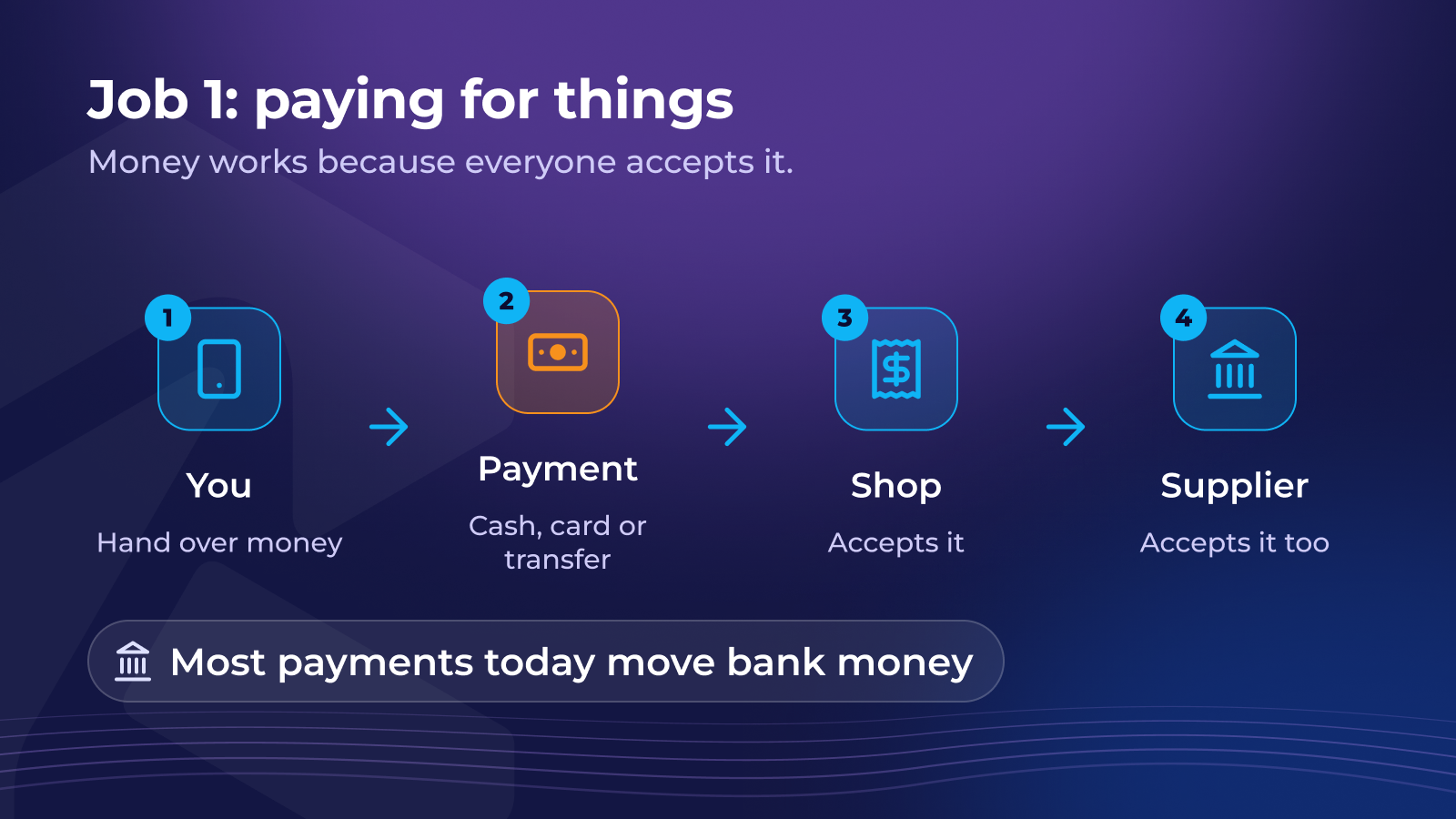
A medium of exchange is anything people accept in return for goods and work. What makes money work is trust: the baker takes your €5 (or $5) because she knows her supplier will take it from her.
Today most payments don't use notes at all. A card payment or a bank transfer moves bank money, a number in an account, from you to someone else. It is still money because everyone accepts it.
This job only works if the thing is widely accepted. A gift card for one shop is a poor medium of exchange: useful there, useless next door.
Quick check
Functions of money: a café lists its prices in euros or dollars on the menu, so you can compare a coffee with a sandwich. Which job of money is that?
Job 2: measuring value
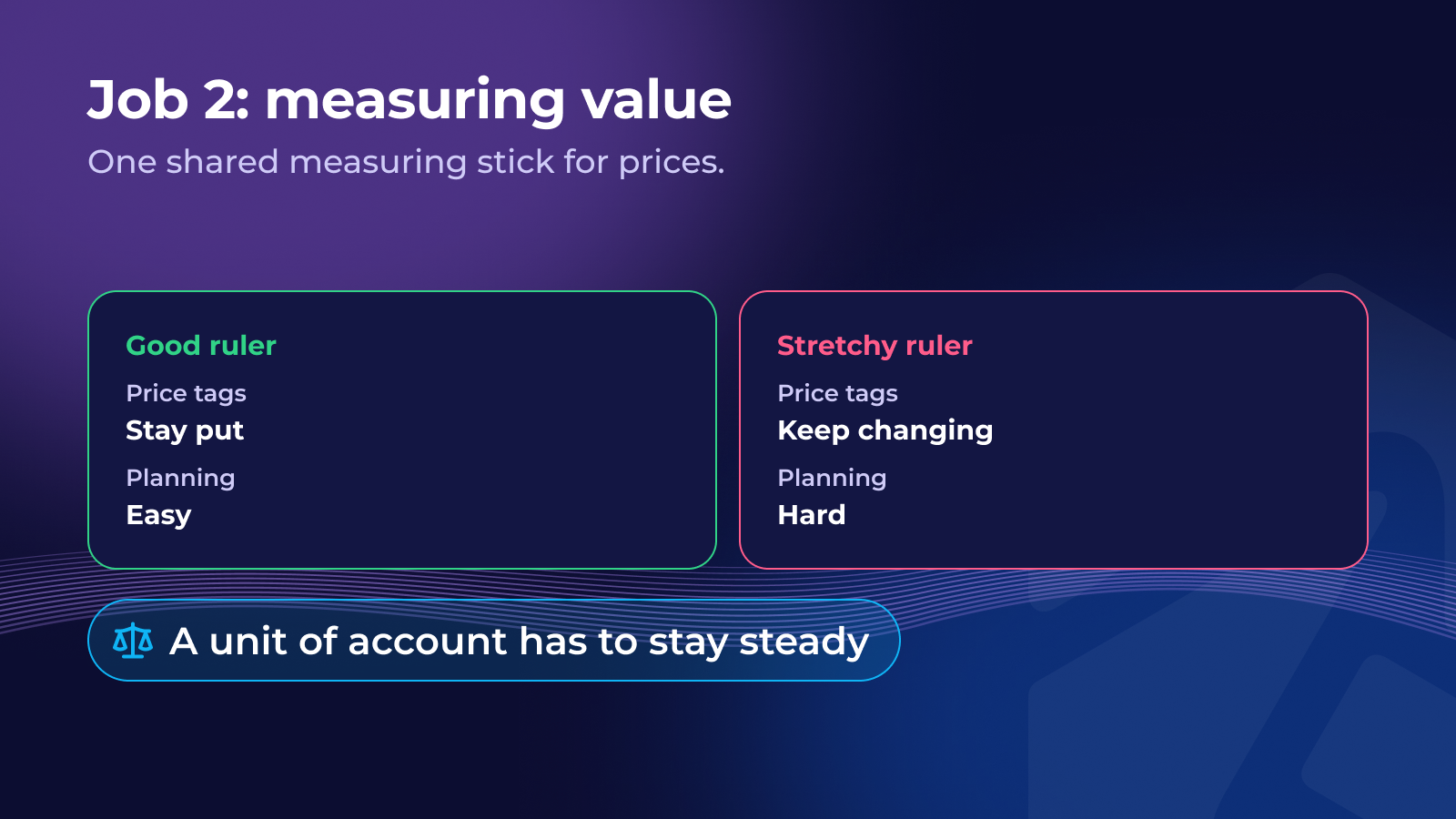
A unit of account is a shared measuring stick for prices. Because rent, coffee and salaries are all written in the same unit, you can ask useful questions: is this phone worth two weeks of food? Does my income cover my rent?
A good measuring stick has to stay roughly the same length. If the unit changed its value a lot from week to week, every price tag, wage and contract would need constant rewriting.
This is the job your budget relies on. When you plan next month in euros or dollars, you trust that 100 will still mean roughly 100 in four weeks.
Job 3: keeping value for later
A store of value lets you earn today and spend later: on holidays, on emergencies, in old age.
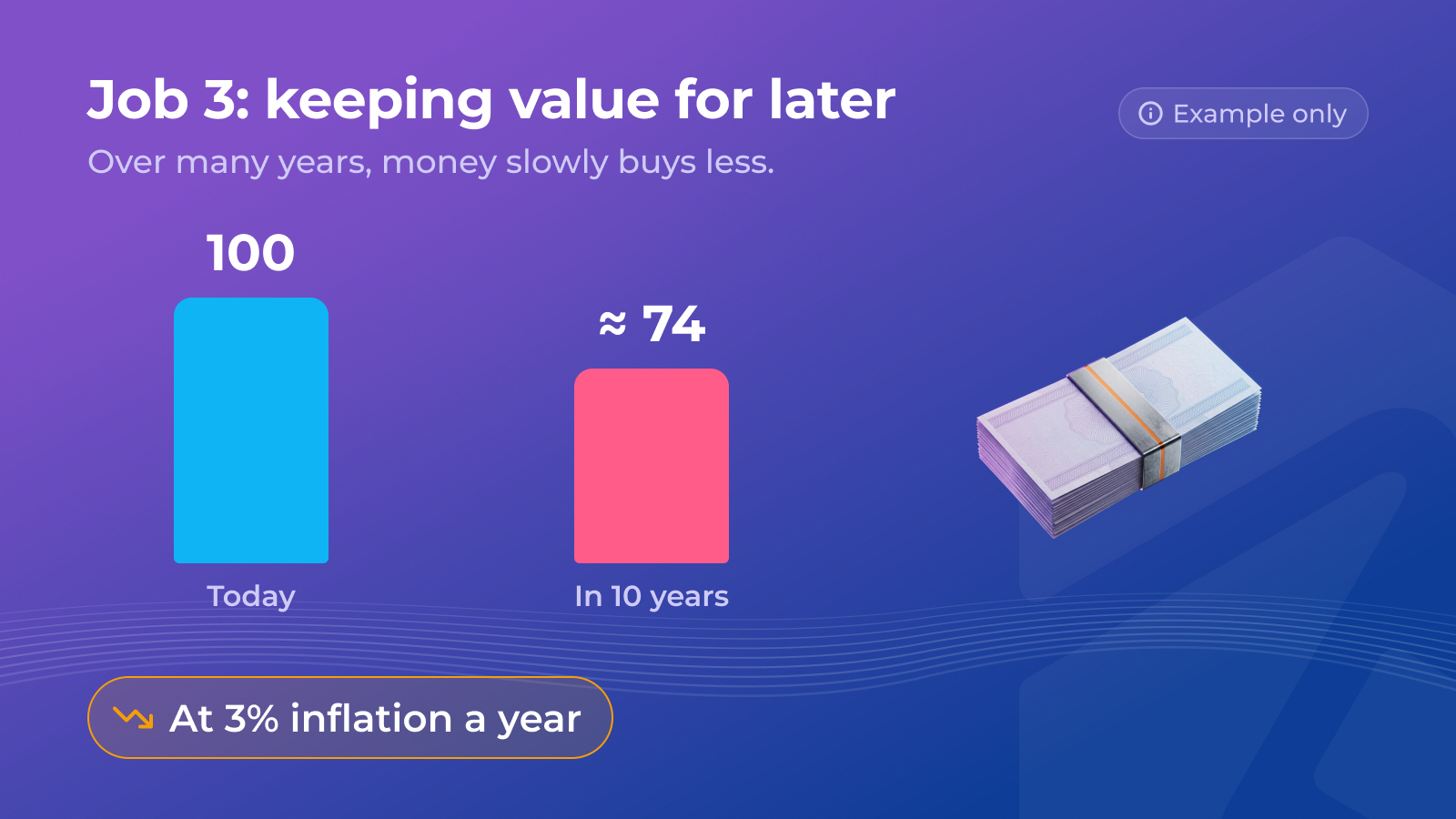
Money is a decent store of value over weeks and months. Over many years it slowly loses buying power, because prices in general tend to rise. That rise is inflation. At 3% a year, for example, 100 buys only about 74% as much after 10 years. The chapter Inflation: Why Cash Shrinks shows how it is measured.
So keeping money has a cost you can't see on your statement: the number stays the same, but it buys a little less each year. That is why savings accounts pay interest, and why long-term plans need more than cash in a drawer.
Quick check
Store of value: Leo keeps €500 (or $500) in a drawer for five years while prices rise every year. What happens to that money?
Cash, bank money and crypto
How do different kinds of money do the three jobs?
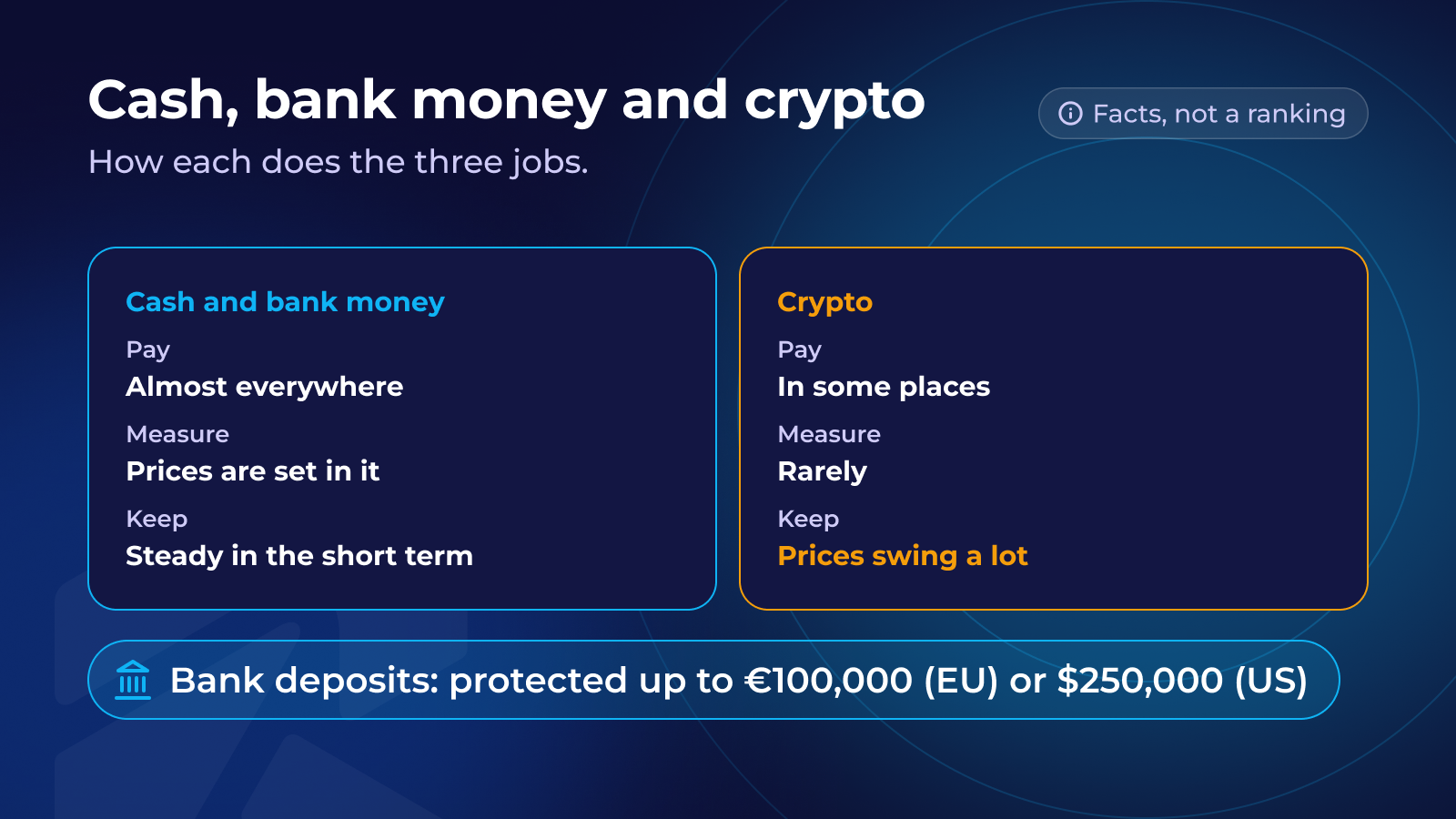
- Cash (banknotes from the central bank, and coins): accepted almost everywhere in person, prices are set in it, and it keeps value well in the short term.
- Bank money (the balance in your bank account): does all three jobs. Deposits at a bank are covered by deposit protection up to a limit: €100,000 per person per bank in the EU, $250,000 per depositor, per FDIC-insured bank in the US. Money held with an app that isn't a bank is not automatically a bank deposit; the provider's terms say what applies.
- Crypto: some people pay with it, but few shops set prices in it, and its value in euros or dollars can change a lot within a day. So it does the jobs unevenly. It is not covered by deposit protection.
Quick check
Functions of money: why do few shops set their prices in a cryptocurrency, even where they accept it as payment?
Recap: what money does
- Money pays (medium of exchange), measures (unit of account) and keeps value (store of value).
- Cash and bank money do all three jobs in daily life; inflation slowly wears down the keeping job.
- Crypto does the jobs unevenly, because its value can swing a lot.
Crypto prices can rise and fall sharply, and you could lose some or all of the money you put in. Crypto is not covered by deposit protection. This lesson is education, not financial advice.
Next: where does your money actually go each month? Where Your Money Goes: Needs, Wants and Leaks
Lesson complete!
0 / 3
That's the first chapter. Continue this course — and unlock the rest — in the Rumos app.