Approaches and Risk: Know Your Limits First
Before “which approach”, ask “how much could I lose?”
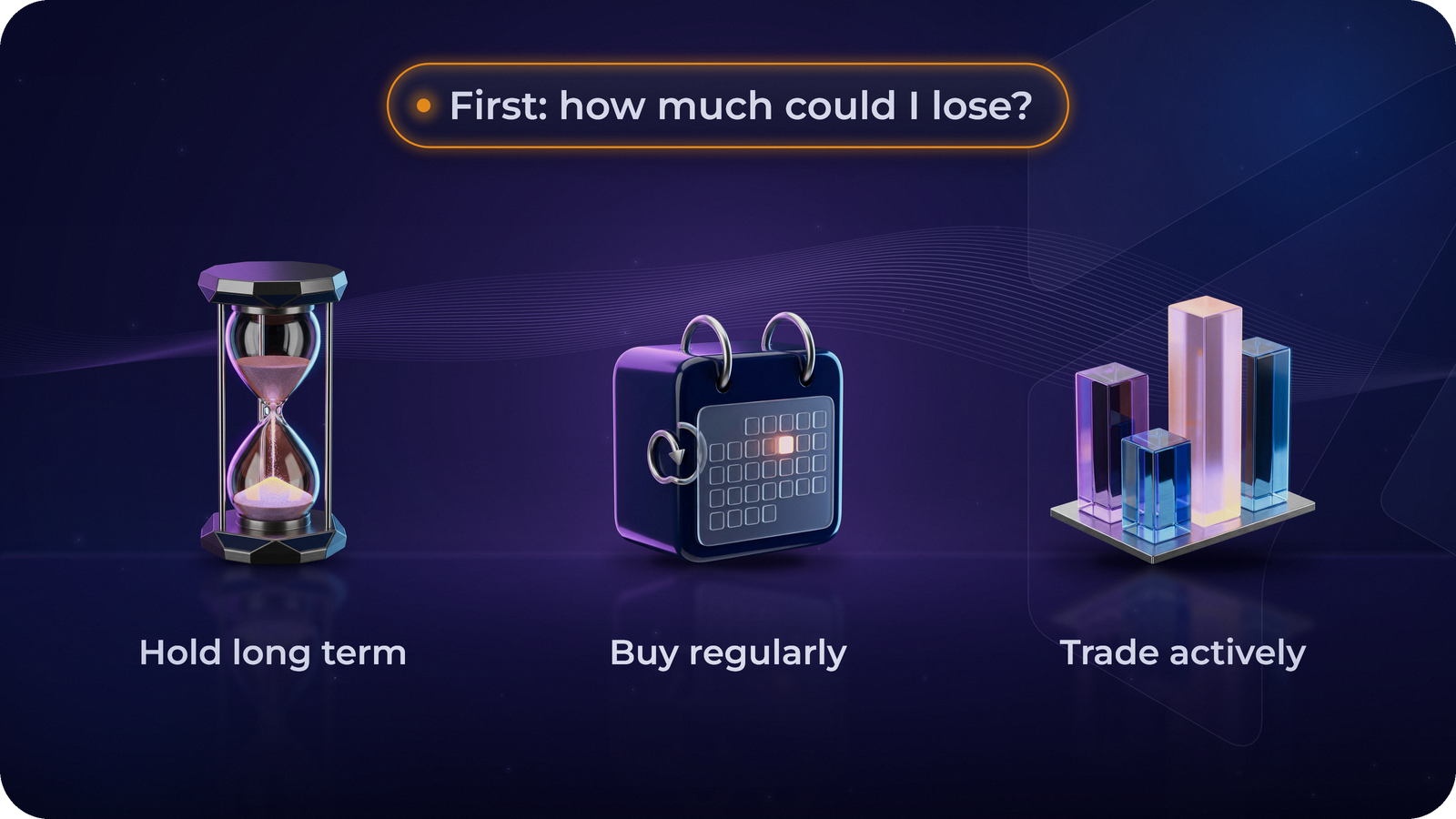
People approach crypto in different ways:
- Long-term holding (often called “HODL”, from an old typo of “hold”): buying and keeping through the ups and downs.
- Regular buying (dollar- or euro-cost averaging): a fixed amount on a schedule, which spreads out the price you pay. Many apps let you schedule a fixed buy.
- Active trading: buying and selling often to try to profit from price moves.
None of them removes the biggest risk: the price can fall a lot and stay low. Holding can mean sitting through falls of 70% or more (Bitcoin fell about 77% from November 2021 to November 2022).
This lesson doesn’t pick an approach for you. It covers what matters with every approach: knowing your limits first.
Active trading: what it costs
Scalping means many trades a day for tiny gains, day trading opening and closing positions within a day, swing trading holding for days or weeks. Crypto trades 24/7, so there is no closing bell to stop for.
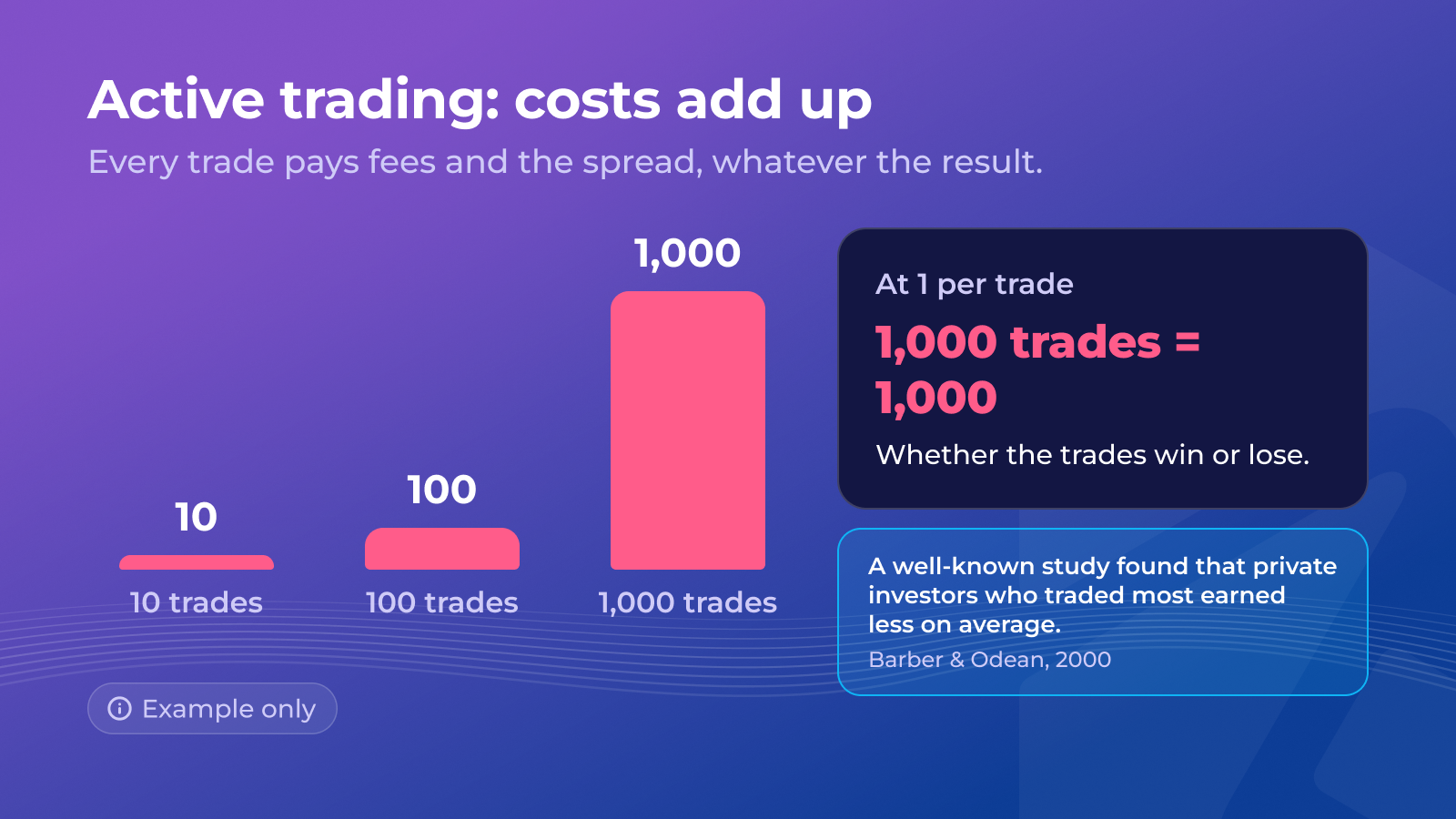
Every trade has a cost: fees and the spread. At a fictional $1 (or €1) per trade, 1,000 trades cost $1,000, whatever the result.
A well-known study of private investors found that those who traded the most earned less on average, mostly because of trading costs and overconfidence (Barber & Odean, 2000).
Quick check
Mia makes 30 crypto trades a day and pays a fixed fee of $1 or €1 per trade. What is certain before any price moves?
Your risk budget and position size
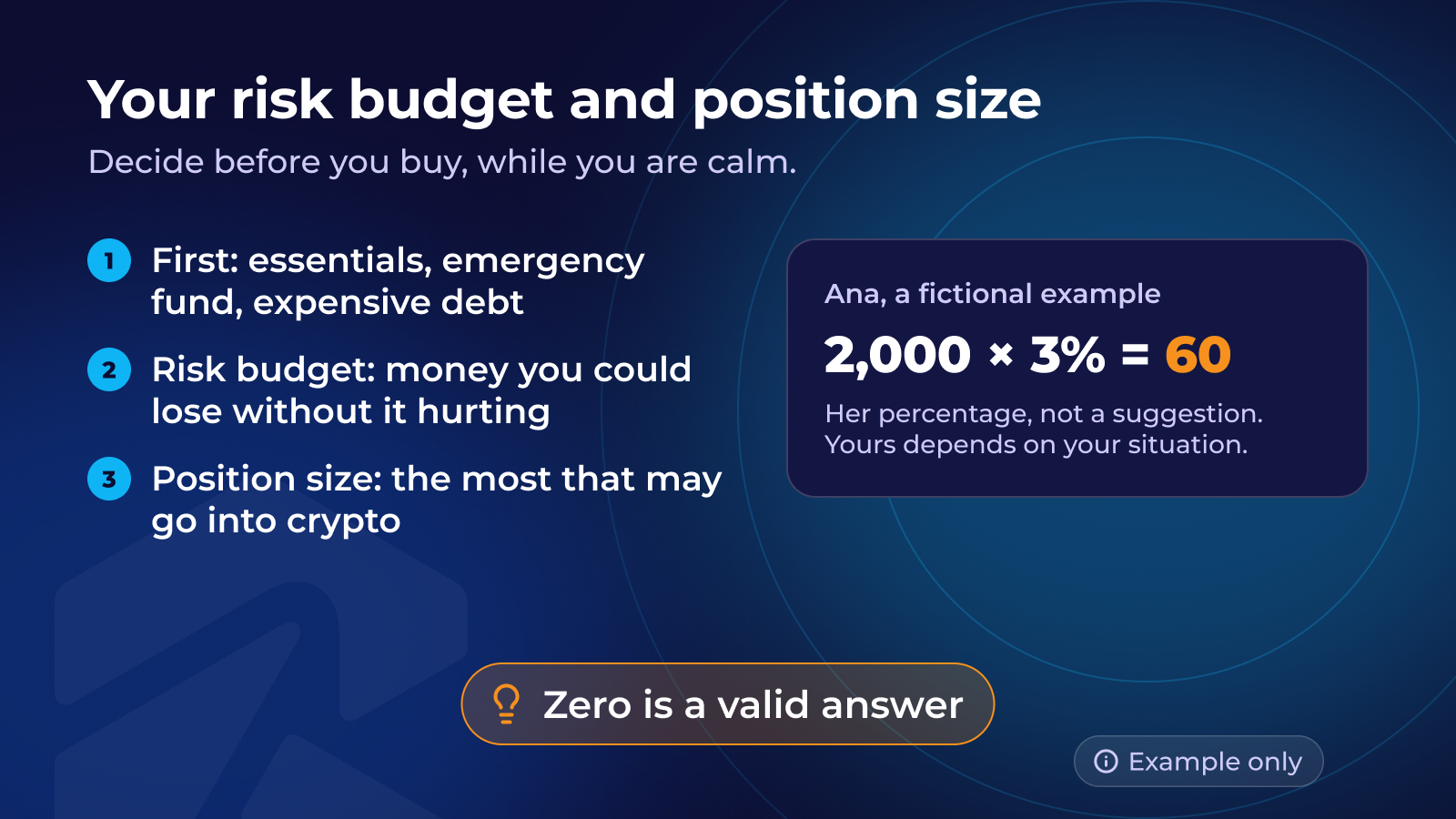
Your risk budget is money you could lose without it hurting your daily life. Work it out from what is left after essentials, an emergency fund and paying off expensive debt, not from your total savings.
Position sizing means deciding in advance whether any of that money goes into crypto at all, and if so, the most it may be and how much any single coin may take. Zero is a valid answer.
A fictional example: Ana has $2,000 left after her emergency fund. She decides crypto may be at most 3% of it: $2,000 × 3% = $60.
Her percentage is hers, not a suggestion; yours depends on your situation. The point is to decide before you buy, when you are calm.
Quick check
Leo has $4,000 or €4,000 in savings after his emergency fund and decides crypto may be at most 8% of it. What is his maximum crypto position?
Exit plans: stop orders and written rules
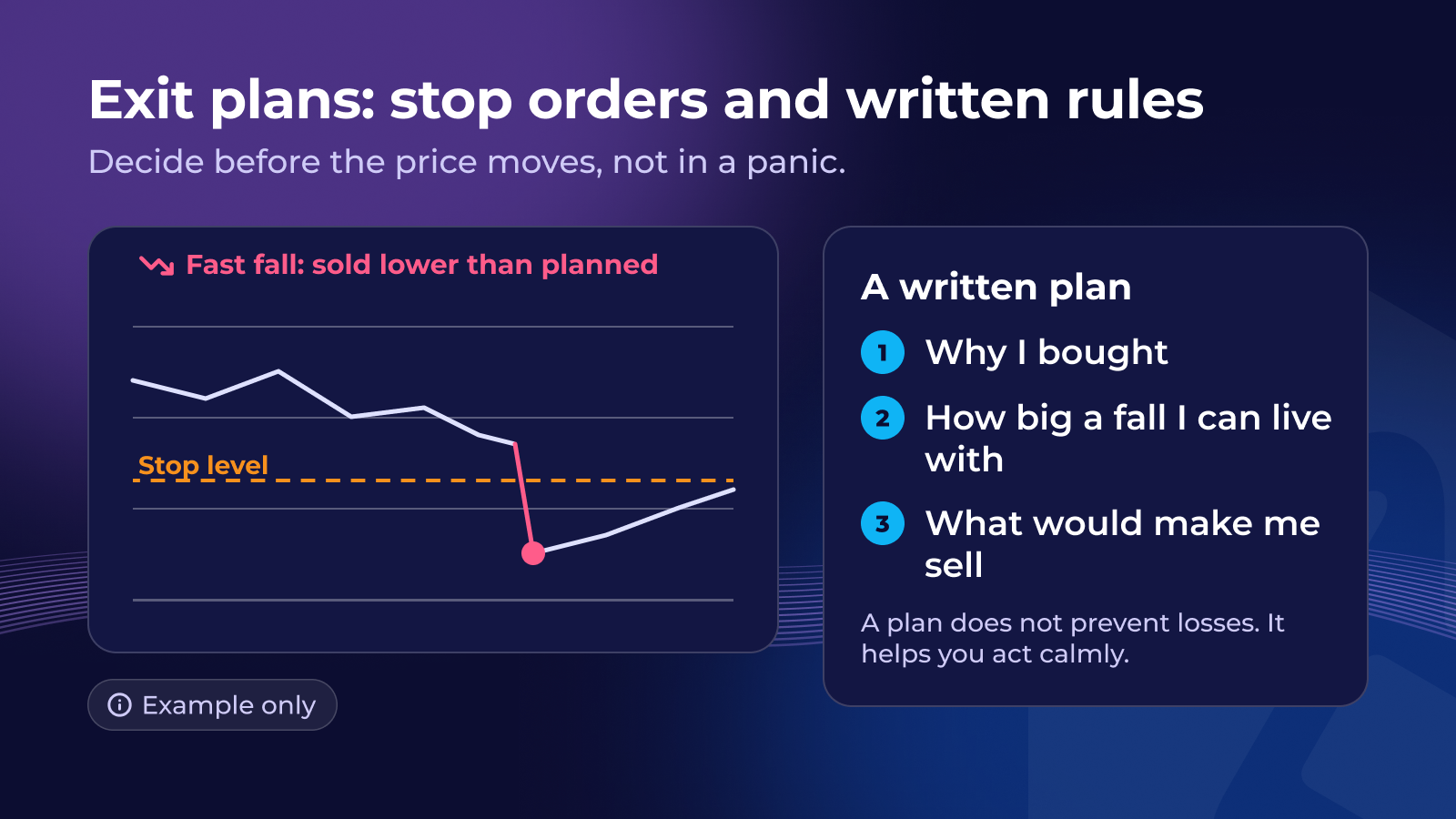
Deciding before the price moves protects you from deciding in a panic.
Some platforms offer a stop order (stop-loss): an instruction to sell automatically if the price falls to a level you choose. It has limits. In a fast fall the price can jump straight past your level, so you sell lower than planned, and a brief dip can trigger it just before the price recovers.
Others keep a written plan: why I bought, how big a fall I can live with, and what would make me sell. A plan only in your head is easy to abandon when emotions run high.
A plan doesn’t prevent losses. It helps you act on decisions made with a clear head.
Leverage: why it hurts
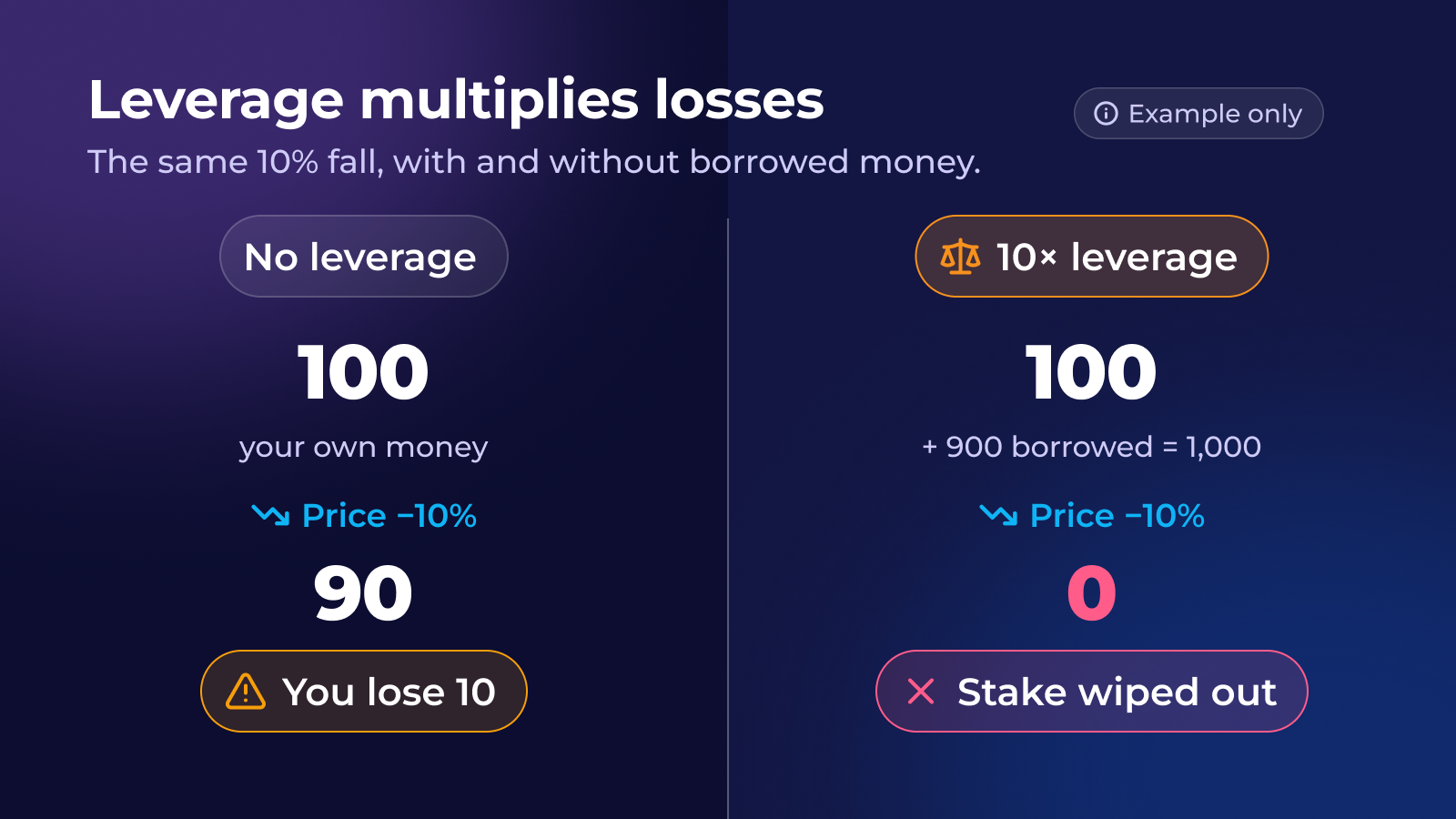
Leverage means trading with borrowed money. With 10× leverage, $100 of your own money controls a $1,000 position.
That multiplies gains and losses. If the price moves 10% against you, the $1,000 position loses $100, your entire stake, and the platform closes the position automatically: liquidation. It often happens a little before −10%, because of fees and margin rules. Without leverage, the same 10% fall would leave you with $90.
Leveraged products also charge ongoing fees for the borrowed money, and in volatile markets a 10% move can happen within hours. Many regulators limit leverage for retail customers, and many beginners avoid it entirely.
Quick check
Before buying crypto, Ana wrote down what she would do if the price fell 50%. Now it has fallen 30% in a week. How does her written plan help?
Recap
- Every approach carries the risk that prices fall; active trading adds certain costs.
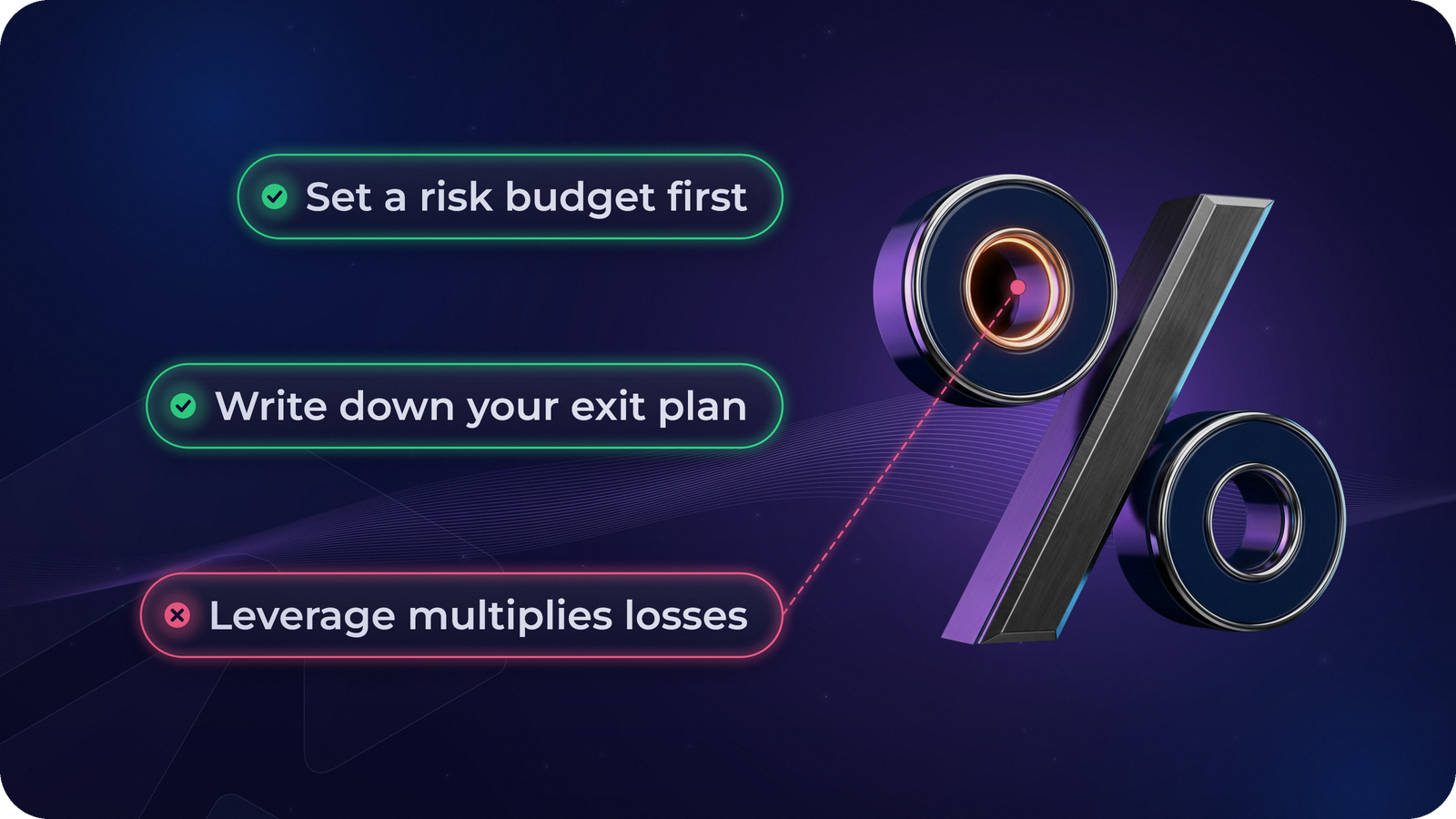
- Set your limits first: a risk budget, a maximum position (zero is valid) and a written exit plan.
- Leverage multiplies losses and can wipe out your stake.
Crypto prices can rise and fall sharply, and you could lose some or all of the money you put in. Crypto is not covered by deposit protection. This lesson is education, not financial advice.
Next: why trading more costs more, in the course “Fees, Spreads and the Real Cost of Investing” in Workshops.
Lesson complete!
0 / 3
That's the first chapter. Continue this course — and unlock the rest — in the Rumos app.