A Map of Crypto: The Main Types
Thousands of coins, a few jobs
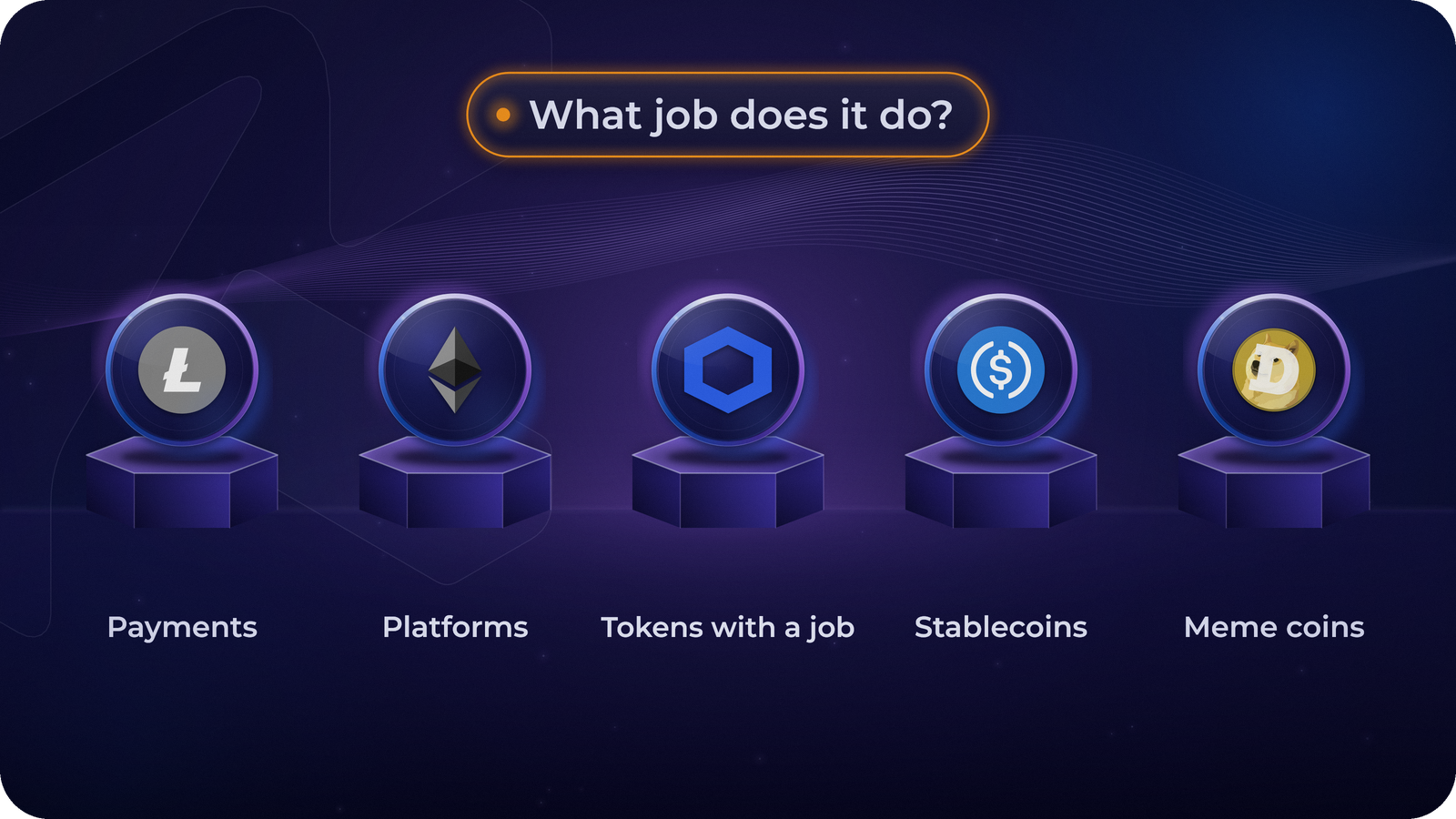
Open any crypto price list and you’ll see thousands of names. It looks chaotic, but most of them do one of a handful of jobs. Think of vehicles: there are countless brands, but only a few kinds, such as cars, buses and lorries.
The most useful question about any crypto-asset is: what job is it built to do? In this chapter you’ll sort crypto into the main types: payment coins, smart-contract platforms, tokens with a job, stablecoins and meme coins.
We use real coins as examples of each type. Naming a coin here describes it; it isn’t a recommendation, and a category says nothing about how a coin will do.
Payment coins
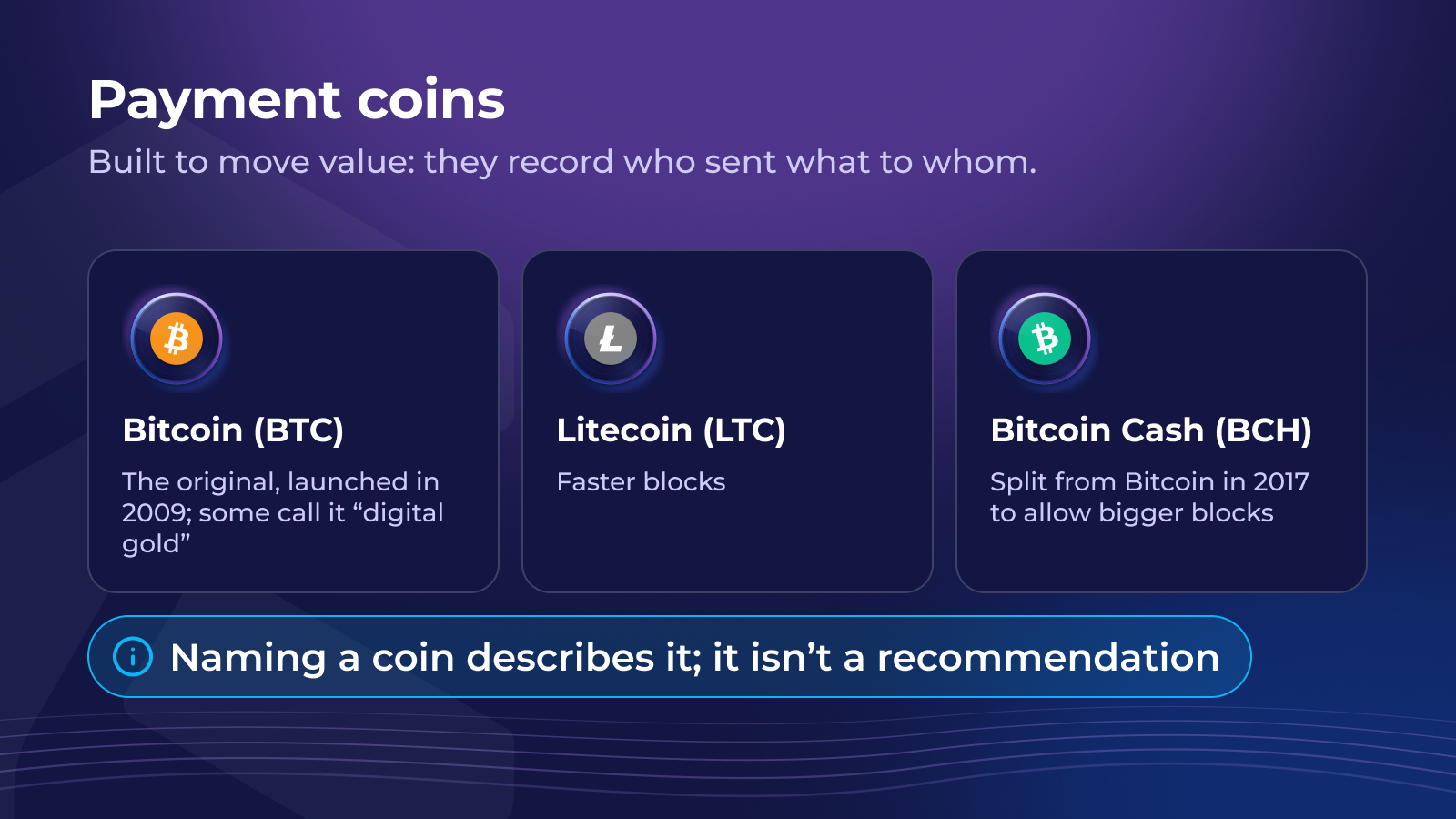
The first job crypto was built for is moving value. Bitcoin (BTC), launched in 2009, is the original. Some people also call it “digital gold” and hold it as a store of value; others dispute that it can play that role.
Other coins focus on payments with different trade-offs. Litecoin (LTC), for example, has faster blocks, and Bitcoin Cash (BCH) split from Bitcoin in 2017 to allow bigger blocks.
These networks mostly do one thing: record who sent what to whom.
Smart-contract platforms
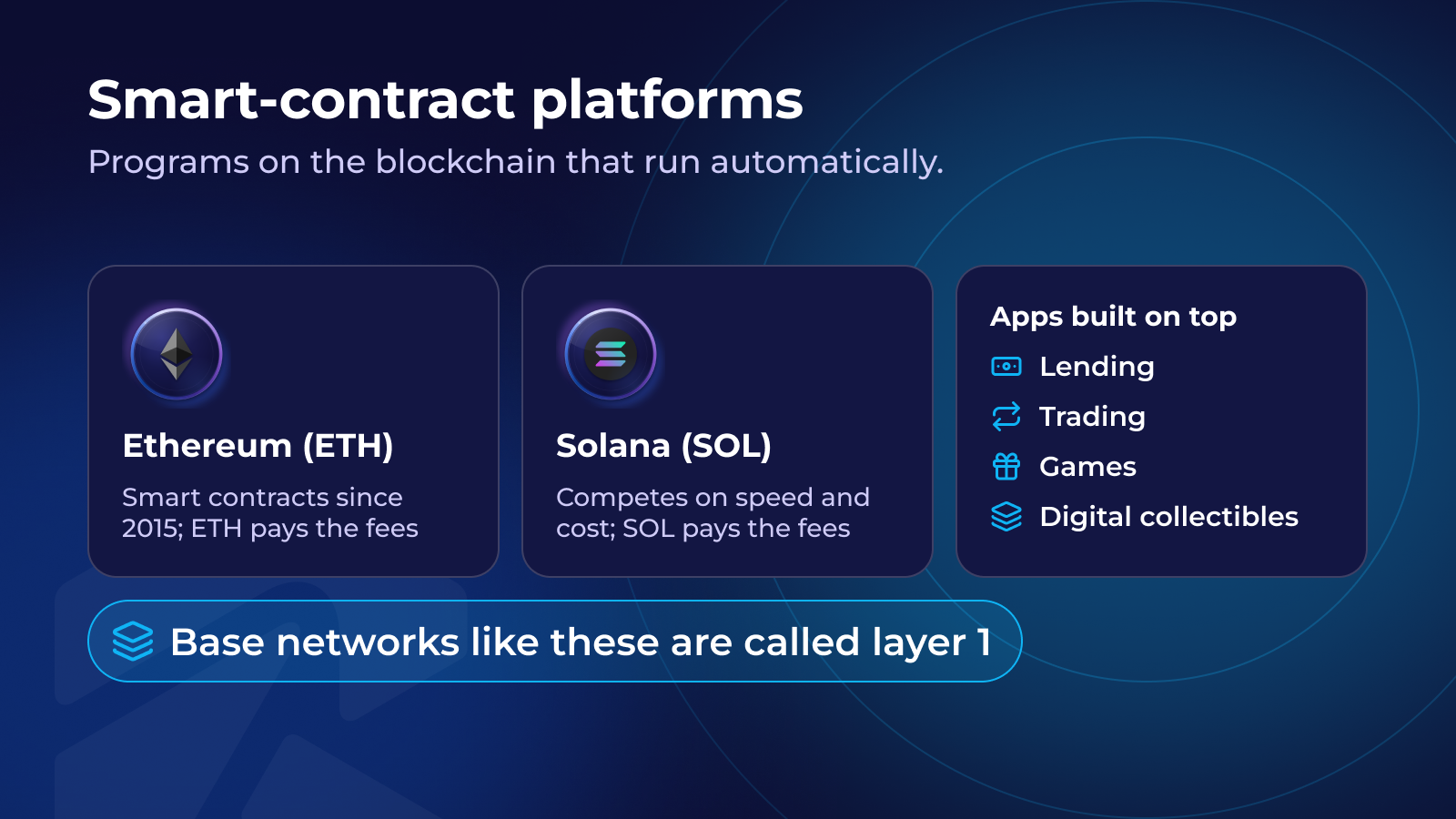
In 2015 Ethereum added something new: smart contracts, programs that live on the blockchain and run automatically. That turned a ledger into a platform where anyone can build apps for lending, trading, games or digital collectibles.
Each platform has its own native coin, used to pay network fees and, on proof-of-stake networks, to secure the network: ETH on Ethereum or SOL on Solana, for example.
Platforms compete on speed, cost, security and how many developers and users they attract. These base networks are also called layer 1 blockchains.
Quick check
A crypto network lets developers run lending and trading apps on it, and charges its fees in its own coin. What type of crypto is that coin?
Tokens with a job
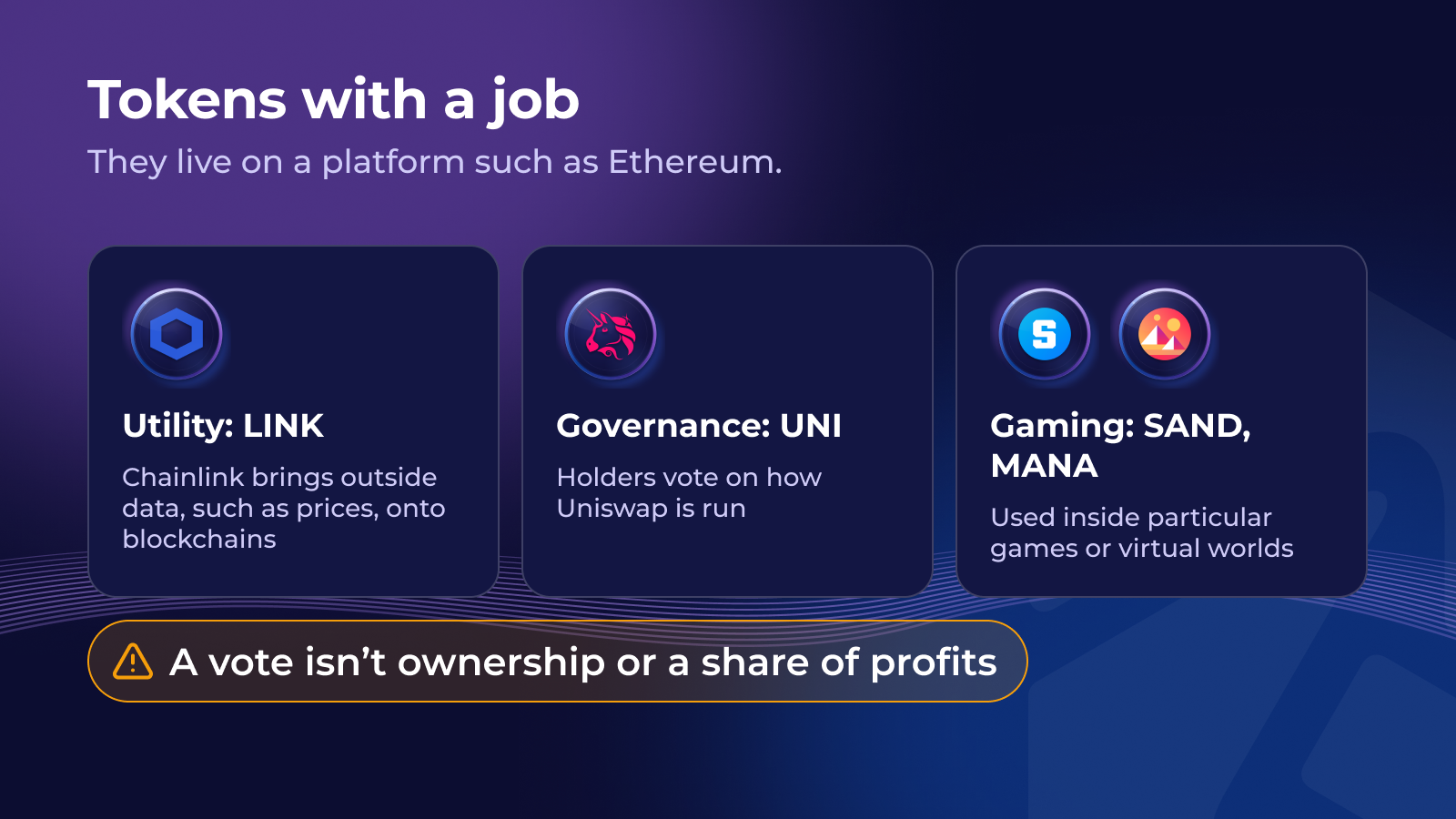
Many crypto-assets don’t have their own blockchain. They are tokens that live on a platform like Ethereum and play a specific role:
- Utility tokens pay for a service, such as LINK (Chainlink, which brings outside data such as prices onto blockchains).
- Governance tokens let holders vote on how a protocol is run, such as UNI (Uniswap). Voting rights are not ownership; they usually bring no share of profits.
- Gaming and metaverse tokens, such as SAND and MANA, are used inside particular games or virtual worlds.
Two opposites: stablecoins and meme coins
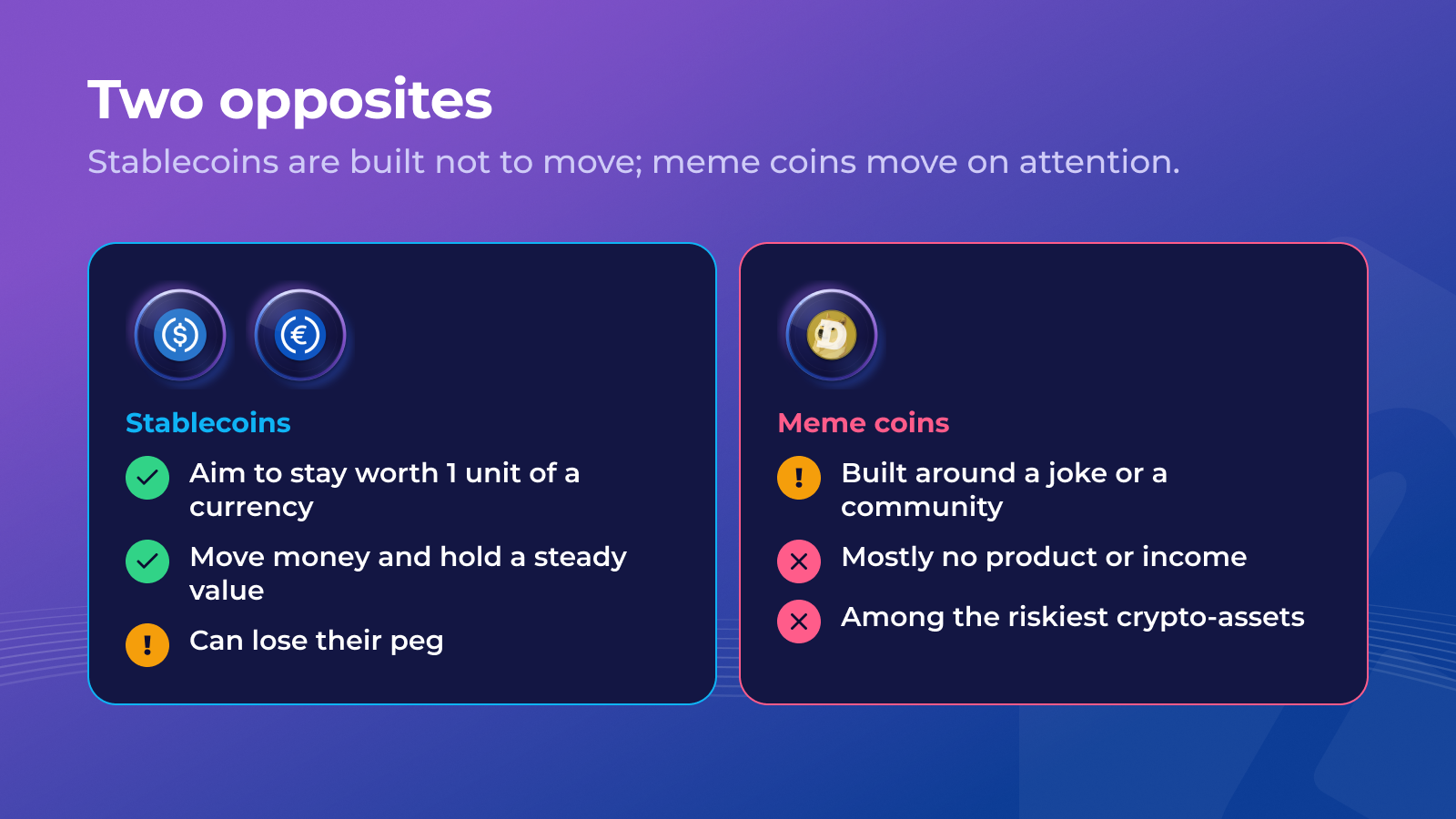
At one end sit stablecoins, built not to move. Each aims to stay worth one unit of a currency: USDC tracks the US dollar and EURC tracks the euro. They’re used to move money on blockchains and to hold a steady value between trades, but they can lose their peg.
At the other end sit meme coins, built around a joke or an online community, such as DOGE. Most have no product or income behind them. Their price moves mostly on attention and speculation, which makes them among the riskiest crypto-assets of all.
Both get their own chapter later in this course.
Quick check
A crypto token gives its holders votes on how a lending protocol is run, but no share of the protocol’s profits. What type of token is it?
Quick check
A crypto token is designed to stay worth one unit of a currency, such as $1 or €1, backed by reserves in that currency held by its issuer. Which type of crypto is it?
Recap: your crypto map
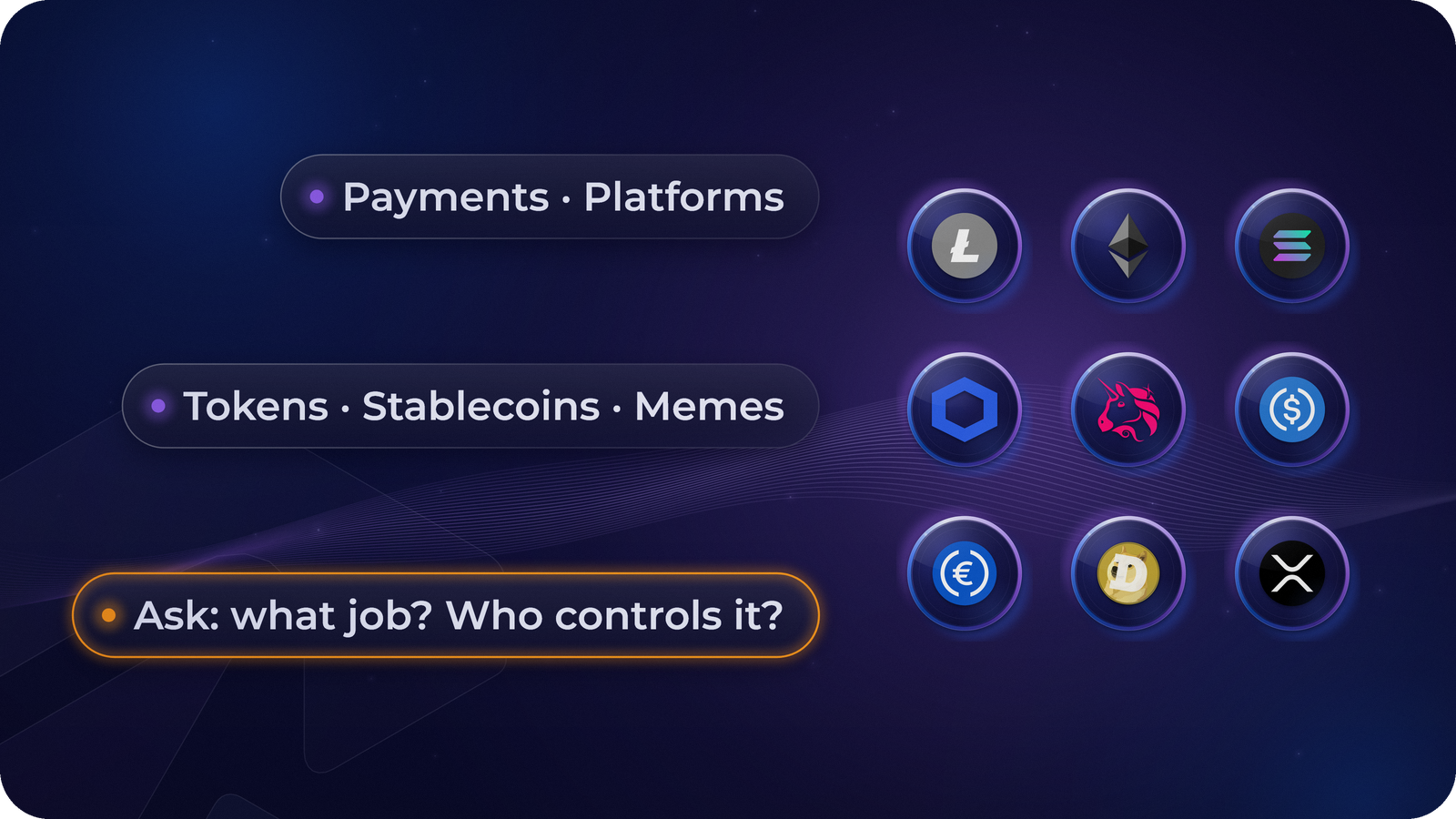
- Payment coins move value, and smart-contract platforms run apps on their own layer 1 blockchains.
- Tokens do a job on a platform: a service, a vote or a game.
- Stablecoins aim to stand still; meme coins move on attention.
Whenever you meet a new coin, ask first: what job is it built to do, and who controls it? Many assets fit more than one box, and a category is not a quality label.
Crypto prices can rise and fall sharply, and you could lose some or all of the money you put in. Crypto is not covered by deposit protection. This lesson is education, not financial advice.
Lesson complete!
0 / 3
That's the first chapter. Continue this course — and unlock the rest — in the Rumos app.