RegulationBeginner7 min
USDT in the EU: what changed in October 2026 and what it means for you
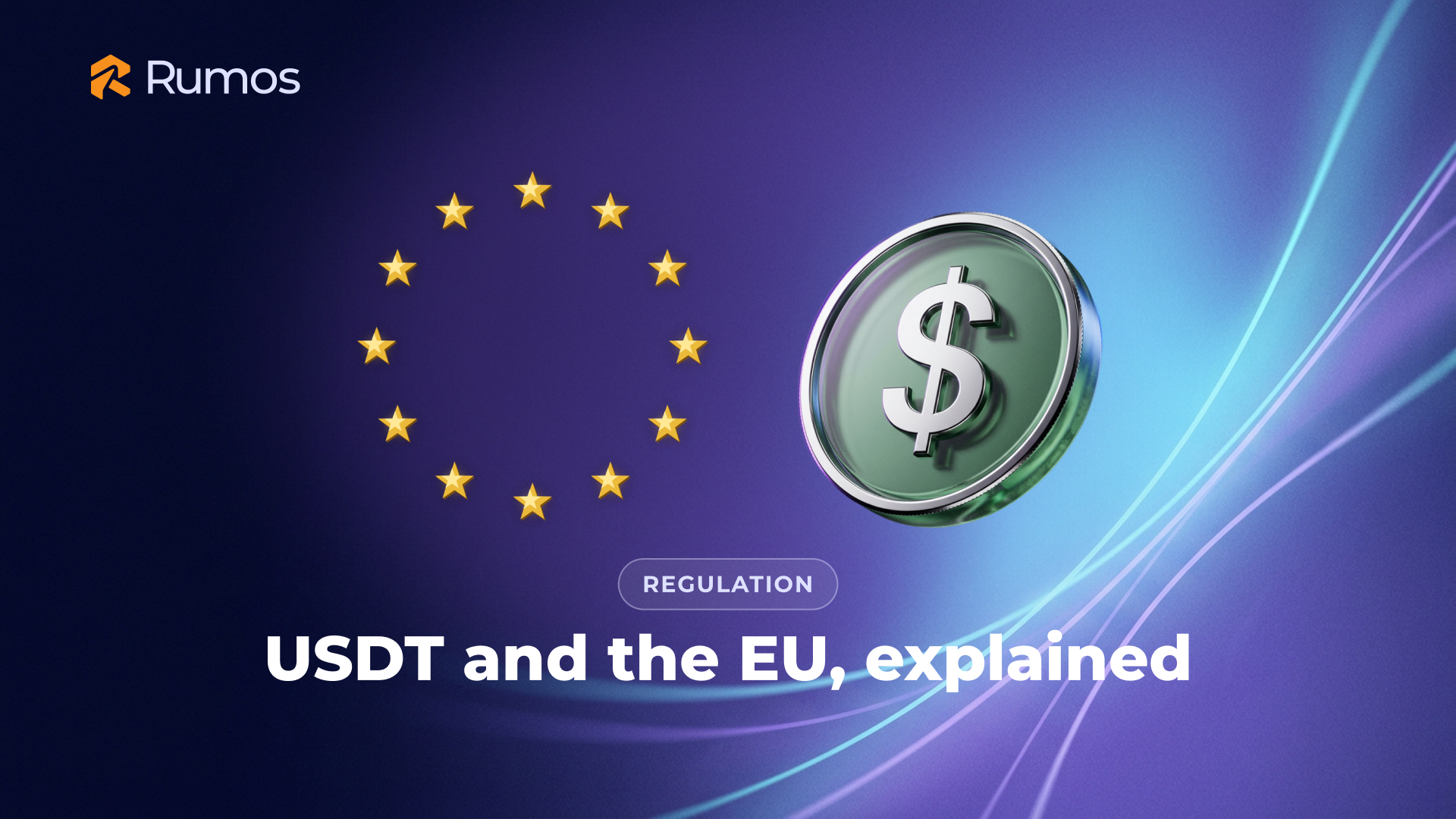
Tether, the company behind USDT, is not in ESMA's MiCA register, so licensed EU crypto firms cannot offer the token. On 8 October 2026 ESMA said they should also wind down custody and transfers. Here is what changed, whether you can still hold USDT, and how the US differs.
By Rumos · yesterday
In this article
You have probably met USDT, the stablecoin issued by Tether. By CoinMarketCap's figures it is the largest stablecoin by market value, yet in the EU it has been leaving licensed crypto apps since late 2024. In October 2026 the EU's markets regulator took the next step. Here is what changed, and what it means for you.
Key points: what is happening to USDT in the EU?
- Tether does not appear in ESMA's public MiCA register, so licensed crypto firms in the EU cannot offer USDT.
- On 8 October 2026, ESMA said those firms should stop all services for such stablecoins, now including custody and transfers, with leftover "legacy exposures" fixed no later than three months after publication.
- The rules are aimed at issuers and crypto firms. We found no rule that bans you from owning USDT.
- In the US, the GENIUS Act stablecoin law takes effect on 18 January 2027.
What is USDT, and why does it matter?
A stablecoin is a crypto token designed to keep a steady value against an official currency such as the US dollar or the euro. New to this? Start with basics about cryptocurrencies.
On 2 November 2026, one USDT traded at $0.9987 and all USDT together were worth about $179.9 billion, according to CoinMarketCap. That is about 2.5 times USDC, a dollar stablecoin issued by Circle. The EU restrictions are about licensing, not USDT's size or price.
What did the EU rule say, and when?
MiCA (Markets in Crypto-Assets) is the EU's crypto rulebook. It calls a stablecoin that tracks one official currency an e-money token. Since 30 June 2024, only an issuer that is a bank or a licensed electronic money institution may offer one to the public in the EU, or others with the issuer's written consent. The issuer must publish a white paper, pay holders back at face value and keep at least 30% of the money it receives in separate bank accounts. Our stablecoins course explains more.
MiCA also licenses crypto firms, called CASPs (crypto-asset service providers), including those offering custody: holding crypto for you. On 17 January 2025, ESMA, the EU's securities markets regulator, said platforms should stop offering trading in stablecoins that do not comply with MiCA, with a "sell only" window until the end of March 2025. But it said "mere custody and transfer of these crypto-assets should remain possible".
Why isn't USDT authorised?
Tether does not appear in ESMA's MiCA register, the public list of licensed crypto firms and stablecoin white papers, and we found no evidence that it applied. Its CEO, Paolo Ardoino, said in May 2025, as reported by Cointelegraph: "I decided to not apply to the MiCA license because I need to protect the 400 million+ users that we have around the world."
In 2024 Ardoino also criticised MiCA's bank-deposit rule, arguing, as reported by The Block, that stablecoins "should be able to keep 100% of reserves in treasury bills".
What changed in October?
On 8 October 2026, ESMA published an opinion to national supervisors saying licensed firms "should not provide crypto-asset services" for stablecoins that do not comply with MiCA. This time the list covers every service, including custody and transfers, and ESMA said warnings to clients are not enough.
Any remaining service should only help clients wind down, "limited to the liquidation, conversion, withdrawal, transfer or safekeeping of existing holdings", for a limited time. Where supervisors find leftover "legacy exposures", they should require a fix "as soon as possible and no later than three (3) months following the date of publication" of the opinion. ESMA gave no calendar date.
The opinion names no token; according to CoinDesk, USDT is the largest stablecoin affected. We found no response from Tether.
Kraken's page for European Economic Area (EEA) clients, updated on 29 October, says USDT "cannot be traded" there but can be withdrawn. According to Unchained, citing Coinbase's help page, Coinbase scheduled a one-time conversion of USDT left in EEA retail accounts for 30 October, into USDC where suitable.
On 14 October, the European Banking Authority (EBA) also classified USDC as the first "significant" e-money token in the EU, bringing its reserves under direct EBA supervision from 12 November 2026.

Can I still hold USDT in the EU?
This is not legal advice. MiCA covers firms and people that issue, offer or list crypto, or provide crypto services. It does not regulate what individuals hold, and both ESMA documents are addressed to firms and supervisors. We found no rule that bans you from owning USDT.
What changes is where you can keep it. Under ESMA's guidance, EU-licensed platforms should not let you buy or swap into USDT, and should only help you wind down what you already have. If you hold some there, check the platform's notices so a deadline does not surprise you.
Neither ESMA document mentions wallets you control yourself, known as self-custody. With self-custody, you alone are responsible for your keys and for spotting scams. Our course on storing cryptocurrencies explains both.
Which stablecoins are in the EU register?
Anyone can check ESMA's MiCA register. Its e-money token list includes Circle Internet Financial Europe with USDC and EURC, Paxos Issuance Europe with tokens including USDG, Quantoz with EURQ and USDQ, and Monerium with EURe, among others. The EBA counts 45 e-money tokens notified under MiCA.
Tether announced investments in Quantoz and in another listed issuer, StablR, but their tokens are not USDT. This is a list of what exists, not a recommendation to buy or switch.

How is the US different?
The US stablecoin law, the GENIUS Act, was signed on 18 July 2025 and requires 1:1 reserves. The Act and the final rule of the OCC, a US bank regulator, take effect on 18 January 2027.
On 27 January 2026, Tether launched a separate US token, USAT, issued by Anchorage Digital Bank, not by Tether. At the launch, Tether said USDT "continues to operate globally" and is "progressing towards GENIUS Act compliance". We found no official decision on USDT's status under the US law.
What to take from this
We found no rule that bans you from owning USDT. Its issuer, by its CEO's own account, chose not to apply for an EU licence, so licensed platforms first stopped selling it and are now expected to wind down holding and moving it too.
What you can do now
- Learn how MiCA, ESMA and the public register fit together in crypto rules in the EU.
- See how market value works in about the crypto market.
- Thinking about keys and wallets? Start with our introduction to security.
Questions readers ask
Is USDT banned in the EU?
We found no rule that bans individuals from owning it. Licensed crypto firms cannot offer it, because Tether does not appear in ESMA's MiCA register.
What is the deadline in ESMA's October opinion?
Supervisors should require leftover "legacy exposures" to be fixed no later than three months after the opinion's publication on 8 October 2026. ESMA gave no calendar date.
Is USDC in the EU register?
Yes. Circle Internet Financial Europe is listed with USDC and EURC. That is a regulatory fact, not a recommendation.
Crypto prices can rise and fall sharply, and you could lose some or all of the money you put in. Crypto is not covered by deposit protection. This article is for education, not financial advice.
Read next
All news-
 Education
Where does an exchange keep your crypto, and what happens when one is hacked?
yesterday -
 Security & Scams
Binance hack of 29 October 2026: about $6.3 billion taken, according to Binance
yesterday -
 Market News
Crypto this week (26 Oct–1 Nov 2026): how markets reacted to the Binance hack
2 days ago