RegulationBeginner8 min
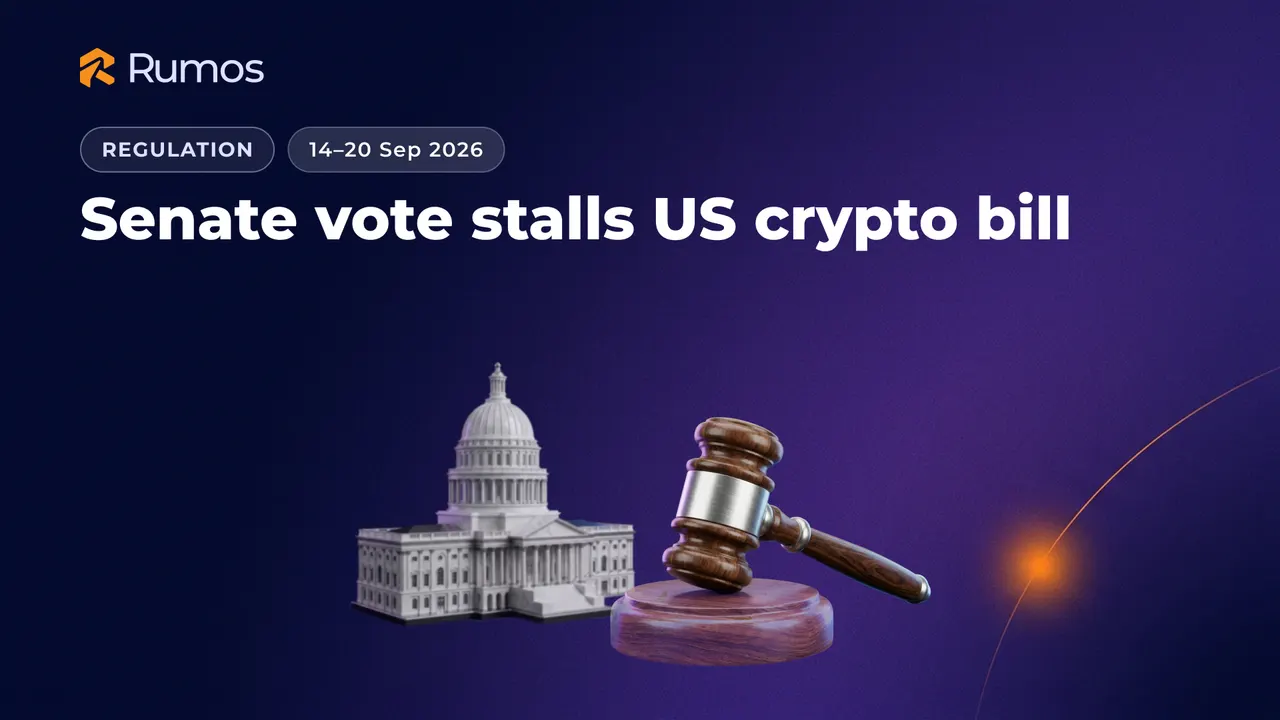
Crypto this week (14–20 Sep 2026): the Senate blocks the CLARITY Act, regulators move on
The US Senate voted 49–50 on starting debate on the CLARITY Act, 11 short of the 60 needed, and crypto fell the same day. Two days later the SEC and CFTC moved on their own, and bitcoin closed the week up 5.61% at $81,143. Plus a Fed rate rise, a flat ETF week and an EU report on Binance.
By Rumos · last mo.
In this article
Some weeks are shaped by one vote. On Tuesday 15 September 2026 the US Senate failed to advance the CLARITY Act, the main US crypto market bill, and crypto fell the same afternoon. Two days later, US regulators moved ahead on their own, and by Friday bitcoin was back above $80,000. Here is the big story of 14 to 20 September, plus three short briefs.
Key points: what happened in crypto this week?
- On 15 September the US Senate voted 49–50 on starting debate on the CLARITY Act. It needed 60 votes.
- Bitcoin hit its weekly low of $74,945 minutes after the result was reported, then closed the week at $81,143 (€70,691), up 5.61% in dollars and 6.67% in euros.
- On 17 September the SEC issued a temporary "innovation exemption" for trading tokenised shares, and the CFTC sent crypto rules to the White House for review.
- The US Federal Reserve raised interest rates by 0.25 points to 3.75%–4.00%, its first increase since July 2023.
- US spot bitcoin ETFs ended the week at +$6.2 million, after a –$450.3 million Tuesday.
The big story: the Senate blocks the CLARITY Act
What the vote was
On Tuesday 15 September the Senate voted on whether to start debate on H.R. 3633, the Digital Asset Market Clarity Act, a crypto market bill the House of Representatives had already passed. This kind of procedural vote, called "cloture", needed 60 votes. The result was 49–50, 11 short. It was a vote on starting debate, not on the bill itself.
All 49 yes votes came from Republicans, and no Democrat voted yes. Republicans Susan Collins, Josh Hawley and Jerry Moran voted no. Thom Tillis also voted no, for procedural reasons (Decrypt); The Defiant says it was to keep the right to ask for a re-vote. Opponents said the ethics rules on officials' crypto holdings were too weak, among other issues; Senator Elissa Slotkin said "the ethics provisions in this bill are simply too thin" (CryptoSlate). Senator Cynthia Lummis, a leading Republican supporter of the bill, had said earlier that day: "It's over."
How markets reacted
CoinDesk's live coverage that day ran under the headline "Clarity Act fails in Senate, sending crypto lower", and its report also pointed to a renewed rise in oil prices and expectations of a US rate rise. Bitcoin (BTC) hit its weekly low of $74,945 (€64,928) at 18:51 UTC, about eight minutes after CoinDesk reported the result. Coinbase shares fell nearly 9% and Circle shares more than 9%. In Asian trading the next day, XRP was down nearly 10% and ether nearly 5% (CoinDesk).
Regulators move without Congress
On Thursday 17 September the Securities and Exchange Commission (SEC), the US securities regulator, issued a "temporary, conditional" exemption it calls an "innovation exemption". It lets qualifying venues trade tokenised US shares, blockchain tokens meant to mirror real shares, on public blockchains. Conditions include that the tokens carry the same rights as the shares, that trading stops when the stock is halted, and, if someone other than the company tokenises its shares, that the company gets written notice and a chance to object. The exemption expires five years after publication. SEC Chairman Atkins called it a bridge "toward durable rulemaking".
The same day, the White House's regulatory review office received an early-stage proposal for crypto rules from the Commodity Futures Trading Commission (CFTC), another US markets regulator. Its content was not made public at the time.
Friday's rebound
On Friday 18 September bitcoin rose above $80,000 at the US market open and passed $81,000 in the afternoon, while US shares fell. About $238 million of bitcoin "short" positions, bets that the price would fall, were forcibly closed, within about $470 million across crypto (CoinDesk). CoinDesk wrote that "the SEC 'innovation exemption' trumped the failure of the Clarity Act". The Block presented the SEC and CFTC moves as context for the rally, not its single cause.
Bitcoin's weekly high was $81,911 (€71,357) on 19 September, and it closed at $81,143 (€70,691). Ethereum (ETH) rose 6.72% in dollars and 7.79% in euros, to $2,643 (€2,303).
Why it matters to you: in a "short squeeze", traders who bet on falling prices are forced to buy back as prices rise, which makes the rise faster. It explains the speed of a move, not its direction.
What happens next
Law firm DLA Piper says the bill "may not advance further before the new Congress in January". Bills not passed in this Congress generally have to be introduced again in the next one, which starts in January 2027.
Why it matters to you: the US still has no single crypto market law. For now, rules will come mainly from the SEC and CFTC under their existing powers, and future officials can change those more easily than a law. The EU took the other route: it has one crypto law, MiCA, whose transition period ended on 1 July 2026. Our course on crypto rules in the EU explains how it works.
Three briefs
1. The Fed raises rates, and bitcoin barely moves
On Wednesday 16 September the Federal Reserve, the US central bank, raised its target range by 0.25 points to 3.75%–4.00%, by 12 votes to 0. Its statement said: "Inflation remains elevated." The Fed's own table shows its previous increase was on 27 July 2023. Bitcoin swung between about $75,000 and $76,500 in the first 40 minutes after the decision, then settled near $75,700, and was at $76,621 the next morning, up 0.88% over 24 hours. CoinDesk's headline: "Bitcoin rises as traders look past the Fed's rate increase".

2. Bitcoin ETFs: a loud Tuesday, a flat week
US spot bitcoin ETFs, funds that hold actual bitcoin and trade like shares, took in $160.0 million on Monday. Then $450.3 million left on Tuesday, the day of the vote and September's largest one-day outflow (TFTC daily data), and $296.0 million left on Wednesday. Thursday brought $159.5 million back and Friday $433.0 million, so the week ended at +$6.2 million. Ether ETFs lost about $140 million, ending a four-week run of inflows.
Why it matters to you: a big red day doesn't mean a red week. Our investment basics course explains how funds work.
3. EU: a press report on Binance's licence bid
On 18 September CoinDesk relayed a Wall Street Journal report that ECB President Christine Lagarde personally intervened to delay Binance's bid for an EU crypto licence through Greece. According to the report, a senior Greek regulator told Binance that Lagarde wanted the decision held until ESMA, the EU's markets regulator, takes over licensing under a proposed EU reform that has not been adopted. The ECB declined to comment and said it has no institutional role in authorising crypto firms; that power rests with national authorities, here Greece's Hellenic Capital Market Commission. Binance said: "We will not comment on speculation," and that it is working toward MiCA authorisation. It withdrew its Greek application in June 2026. The report is unconfirmed.
Why it matters to you: under MiCA, a national regulator grants the licence, which then works across the EU. Since 1 July 2026, firms without one must wind down their services to EU clients (ESMA).
What to take from this week
The Senate said no, and regulators went ahead with the powers they already have. Prices fell after the vote, alongside oil and rate worries, and were higher by Friday. Bitcoin funds had the month's largest outflow day so far and still ended the week slightly positive. One day's headline rarely tells the whole week.
What you can do now
- Learn why prices react to rates, oil and forced selling in about the crypto market.
- Understand how interest rates affect saving and borrowing in money foundations.
- New to tokens and blockchains? Start with basics about cryptocurrencies.
Questions readers ask
What was the result of the CLARITY Act vote?
On 15 September 2026 the Senate voted 49–50 on starting debate on the bill. It needed 60 votes, so the bill did not advance.
Can the CLARITY Act come back?
DLA Piper says it "may not advance further before the new Congress in January". Bills not passed generally have to be introduced again in the next Congress, from January 2027.
What did the Fed decide on 16 September 2026?
It raised its target range by 0.25 points to 3.75%–4.00%, by 12 votes to 0, its first increase since July 2023.
Crypto prices can rise and fall sharply, and you could lose some or all of the money you put in. Crypto is not covered by deposit protection. This article is for education, not financial advice.